
What a FELA Lawyer Does to Maximize Your Railroad Injury Settlement
Key Takeaways
- FELA requires proof of railroad negligence, not no fault benefits, but pays full uncapped tort damages, including pain and suffering.
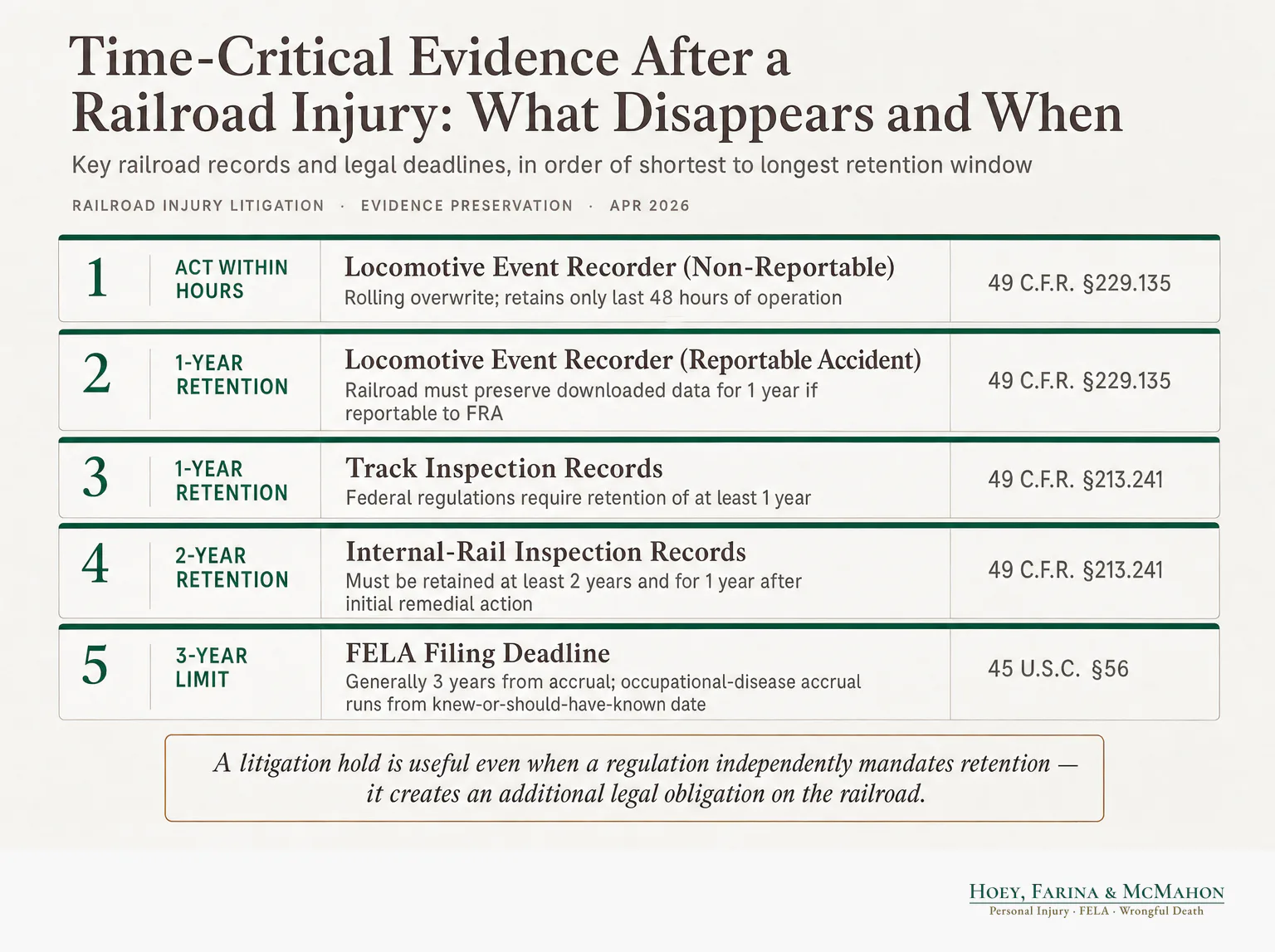
- Federal rules require covered locomotive event recorders to record the most recent 48 hours of operation, and devices are typically designed not to greatly exceed that minimum, so preservation demands cannot wait.
- Proving an employee safety statute violation bars any contributory negligence reduction under 45 U.S.C. § 53.
- In fiscal year 2020, seven of 308 terminated federal FELA cases reached trial, nontrial endings aren't all settlements.
- Claims must be filed within three years of accrual; occupational disease accrual turns on when the worker knew of the condition and its work related cause.
*Written by William J. McMahon, Attorney & Managing Partner.* William J. McMahon is a trial attorney and partner at Hoey, Farina & McMahon in Chicago, representing injured railroad workers nationwide in FELA and FRSA cases. He is SMART-TD Designated Legal Counsel, a member of the Academy of Rail Labor Attorneys, and admitted to the United States Supreme Court and federal district courts across ten states. His verdicts include $10 million and $2.3 million for injured railroaders, the firm's record includes a $33 million FELA verdict, and Leading Lawyers named him a Top Ten FELA attorney in Illinois in 2021 and 2022.
Railroad claim agents can reach an injured worker within hours, collecting photographs, statements and measurements for the railroad. SMART Transportation Division tells members plainly that these agents and attorneys "work for the railroad, not for you." A FELA lawyer's work starts in that same hour from the opposite direction. Under the Federal Employers' Liability Act (FELA), a railroad worker recovers only by proving the railroad's negligence played some part in the injury, and most of that proof sits in records the railroad controls and may lawfully overwrite.
How FELA Differs from Workers' Compensation and Why That Changes Everything
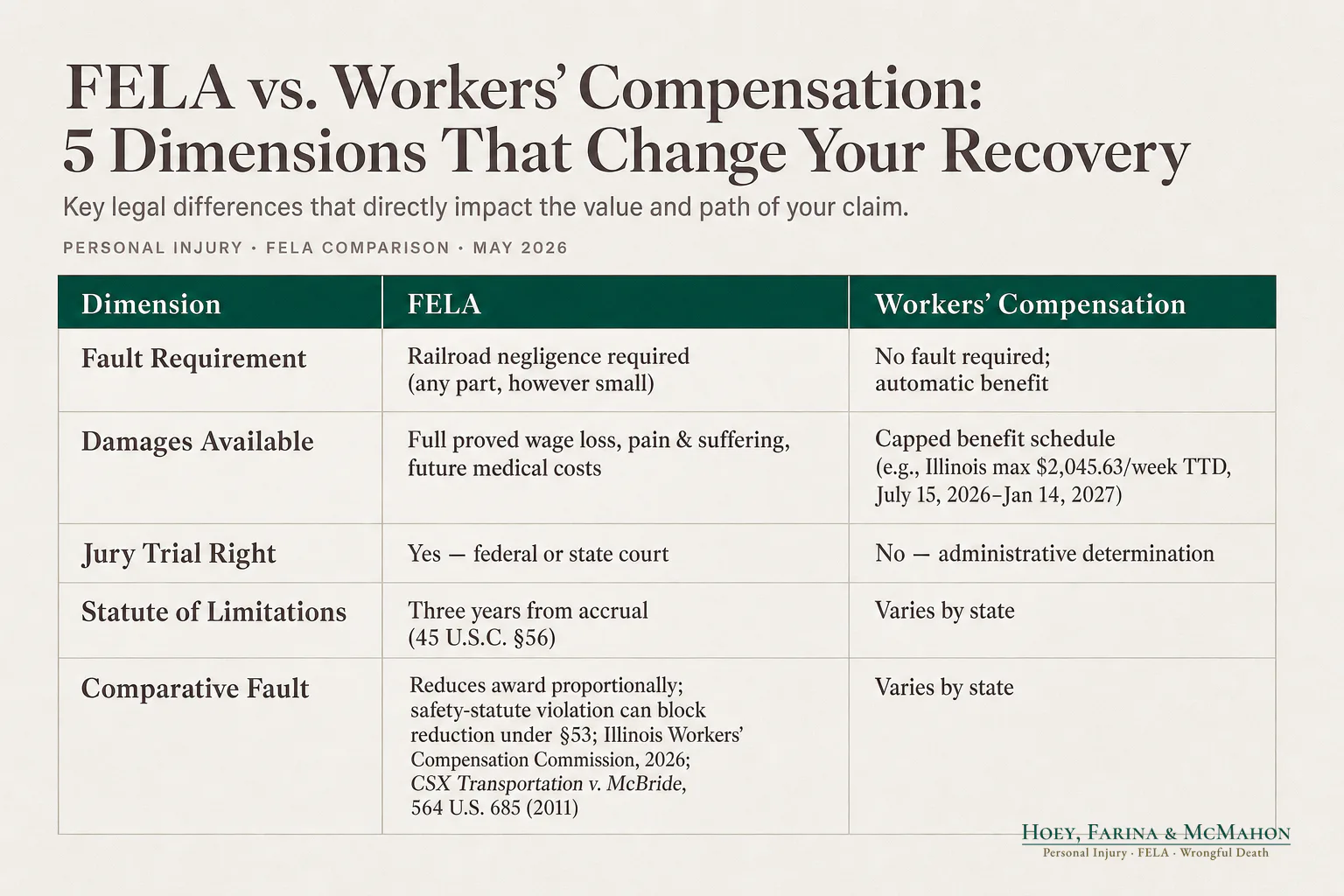
FELA replaces workers' compensation for railroad workers, trading guaranteed benefits for full tort damages in a railroad injury claim.
FELA is a negligence statute, not a no fault system
45 U.S.C. § 51 imposes liability where injury results "in whole or in part" from carrier negligence. A FELA claim reaches wage loss, lost earning capacity, medical costs and pain and suffering, with no benefit schedule.
The causation standard is reduced, not eliminated
Under Rogers v. Missouri Pacific R. Co., 352 U.S. 500 (1957), and CSX Transportation, Inc. v. McBride, 564 U.S. 685 (2011), the U.S. Supreme Court held carrier negligence need only play any part, however small, McBride rejected stock proximate cause instructions. That relaxed rule reaches causation only, negligence still requires foreseeability, "an essential ingredient" of FELA negligence (Gallick v. Baltimore & Ohio R. Co., 372 U.S. 108 (1963)).
Comparative fault reduces recovery but does not bar it
The McBride jury awarded $275,000 but found the worker about one third at fault, and the final judgment was about $184,250, a reduction of roughly $90,750. Section 53 is comparative fault, it ignores worker negligence entirely where the railroad violated a safety statute. Assumption of risk is no defense, 45 U.S.C. § 54, Tiller v. Atlantic Coast Line R. Co., 318 U.S. 54 (1943) (1939 amendment obliterated the doctrine). FELA is not strict liability.
What a FELA Lawyer Actually Does in the First 60 Days
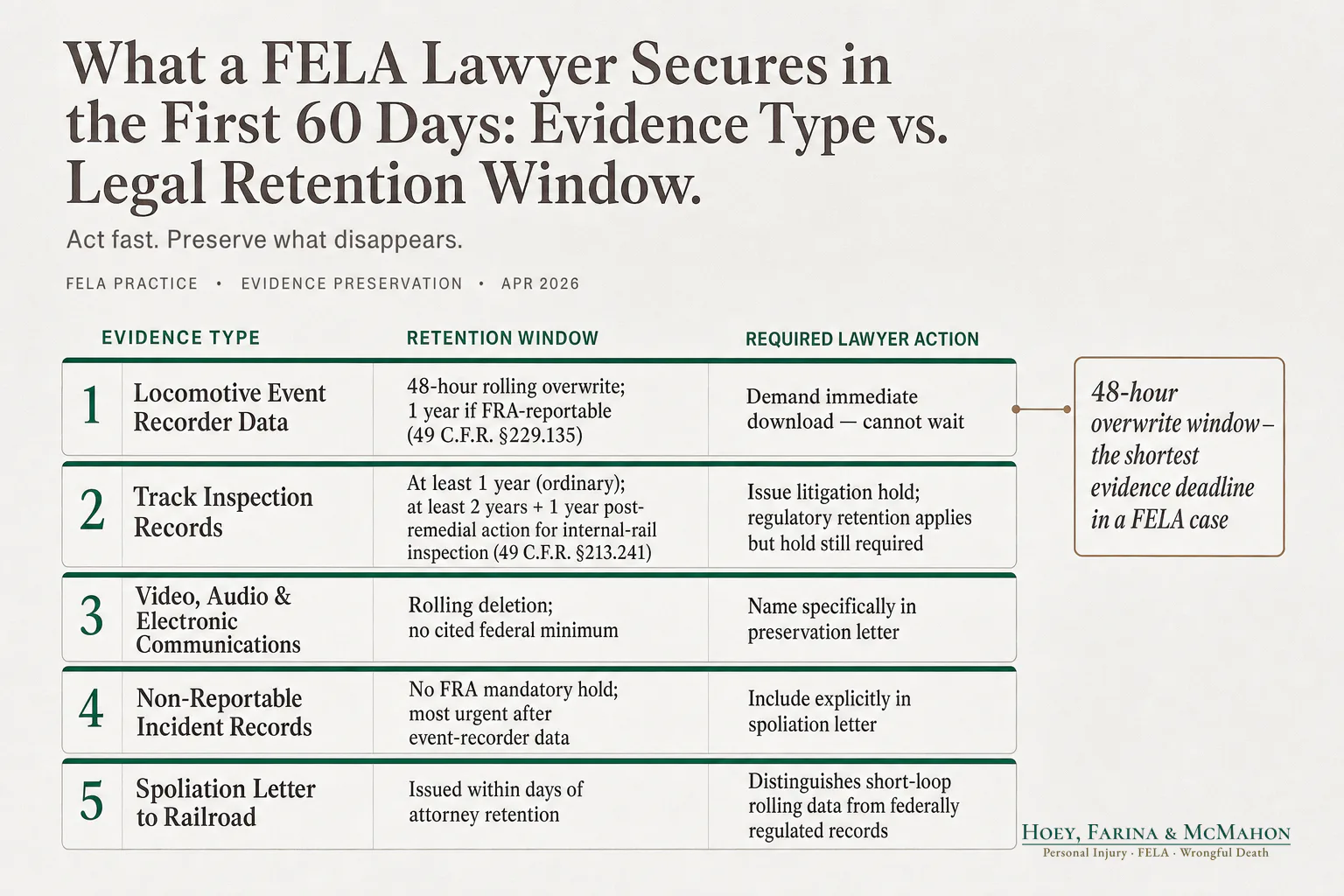
The first two months decide what evidence survives, the early FELA claims process is preservation, regulatory analysis and contact control.
Preserving evidence the railroad controls
A covered locomotive event recorder must record the most recent 48 hours of operation, and devices are typically designed not to greatly exceed that minimum, though reportable accident data must be preserved one year (49 C.F.R. § 229.135). Track inspection records are held one year, internal rail inspection records generally two (49 C.F.R. § 213.241). Video, audio and electronic messages have no regulatory floor, so the litigation hold goes out first.
Identifying the applicable federal safety regulations
Kernan v. American Dredging Co., 355 U.S. 426 (1958), establishes that a railroad's safety statute violation is negligence per se, a rule McBride presupposes, but that requires naming the exact provision, the protected class and the causal link. Theories under the Federal Railroad Safety Act (FRSA), the Safety Appliance Act or the Locomotive Inspection Act do work ordinary negligence cannot, particularly where defective railroad equipment caused the injury.
Blocking the early settlement push
Once the worker is represented, the railroad's lawyers and anyone acting at their direction may not negotiate directly with him (ABA Model Rule 4.2). Claim agents are usually non-lawyer employees, so the rule restrains the railroad's counsel and anyone acting at counsel's behest, not the worker, and a volunteered recorded statement can still damage the claim. An offer accepted before prognosis, work restrictions and future treatment are known undervalues the injury permanently.
What a FELA Lawsuit Looks Like From Filing to Resolution
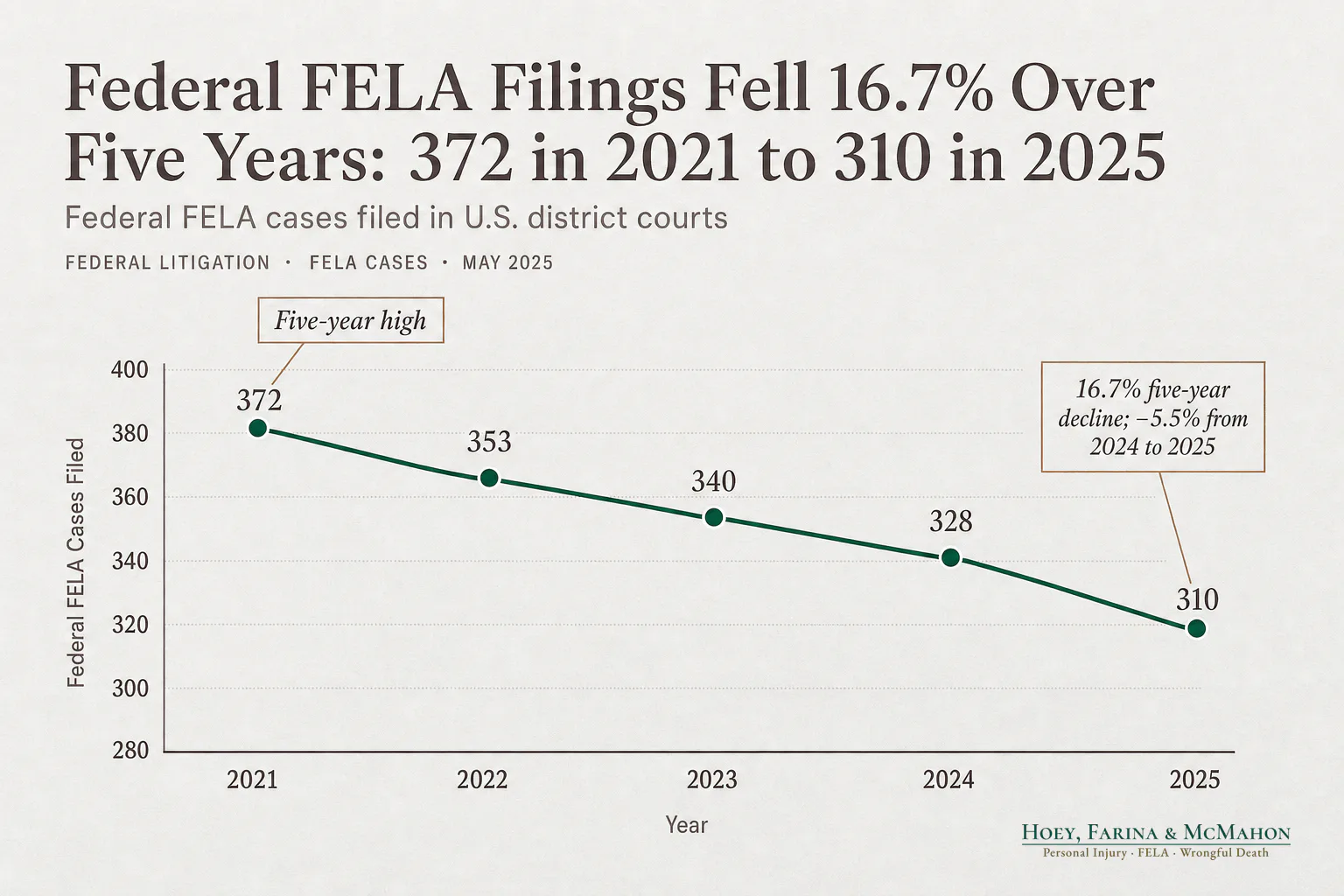
A FELA lawsuit may be brought in federal or state court, but forum choice is constrained, and federal filings have been shrinking.
Where a FELA lawsuit can be filed
45 U.S.C. § 56 sets a three year limitations period, allows suit where the railroad resides, where the claim arose, or where the railroad does business, and makes federal jurisdiction concurrent with the states. State court filings are not removable under 28 U.S.C. § 1445(a). In BNSF Railway Co. v. Tyrrell, 581 U.S. 402 (2017), the Supreme Court held that doing business in a state does not by itself create general jurisdiction.
Discovery and the railroad's document obligations
Properly framed requests reach maintenance histories, prior incident reports and supervisor communications, where deferred maintenance and repeated complaints surface, undercutting the railroad's isolated human error story.
How most cases resolve
Federal FELA filings fell from 372 in 2021 to 309 in 2025, about a 16.9% decline, with 353 in 2022, 340 in 2023 and 310 in 2024, so the 2024 to 2025 change was about 0.3%, per Judicial Business Tables C-2A and C-2 from the Administrative Office of the U.S. Courts. Of 308 federal Employers Liability Act terminations in fiscal 2020, seven reached trial, a 2.3% trial rate. Nontrial termination covers settlements, dismissals and judgments alike, so it measures how rarely juries decide these cases, not how often railroads pay.
How FELA Injury Settlements Are Valued and What Drives the Number
FELA injury settlements combine proved economic and noneconomic loss, less comparative fault, adjusted for evidence, venue and trial risk.
The damages a FELA claim reaches
Medical expenses, lost earnings, diminished earning capacity and pain and suffering are recoverable, wrongful death adds survivor losses. Nothing is capped, so proof quality sets the ceiling, for a shoulder injury, a back injury or occupational disease.
What a FELA settlement calculator can and cannot tell you
A calculator returns a range, not a valuation, economic loss plus a multiplier or per diem estimate with method undisclosed. FELA recognizes no such formula, and none prices comparative fault, the regulation violated, or the railroad's venue posture.
How the railroad defends the number
The railroad argues preexisting degeneration, treatment gaps and the worker's own conduct. Medical chronologies and vocational proof isolate the railroad's contribution, a safety statute violation blocks proportional reduction.
What Distinguishes a FELA Lawyer from a General Personal Injury Attorney
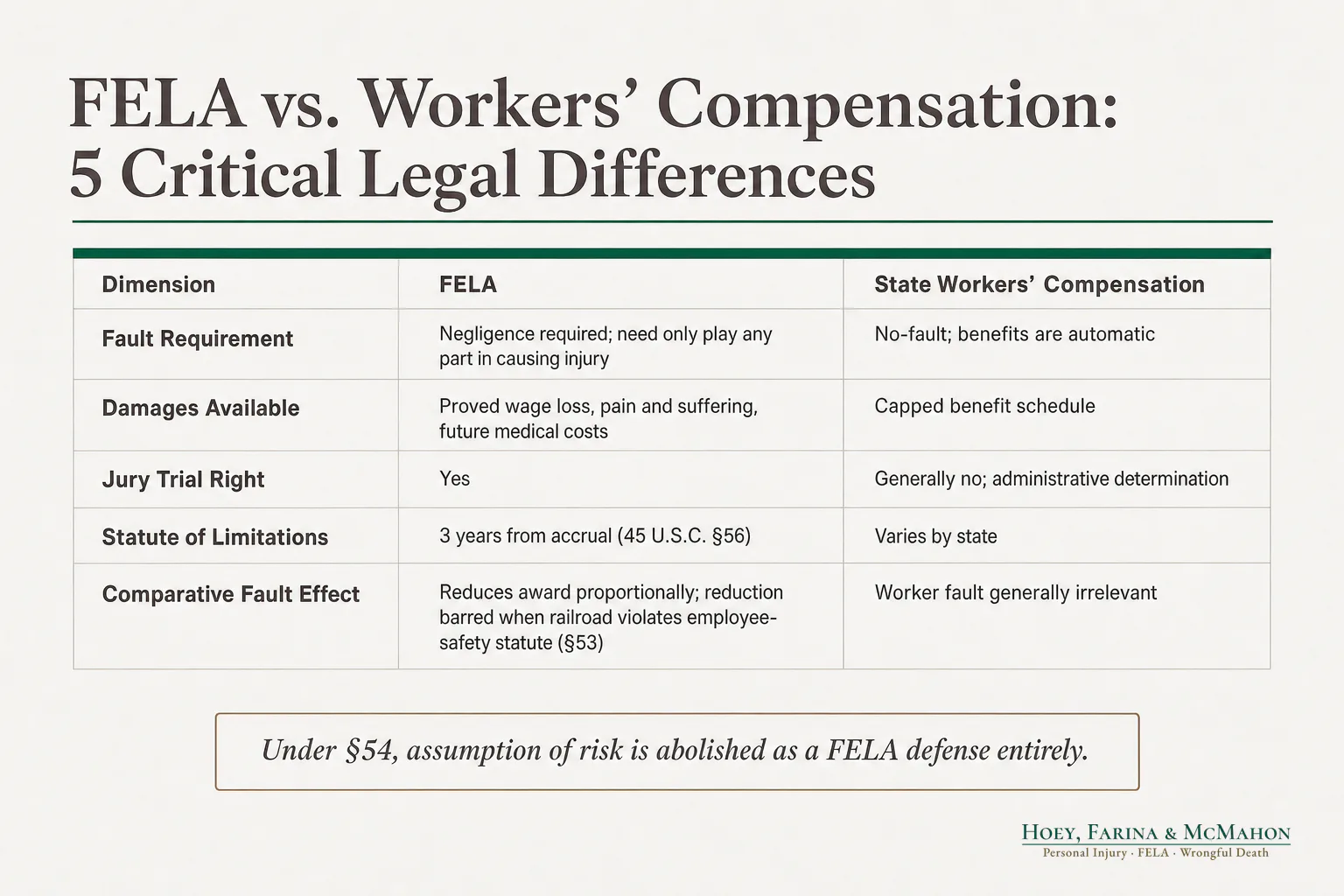
A general personal injury attorney works in state common law negligence. A FELA lawyer works inside a federal statute with its own causation rule, defenses, preemption questions and Supreme Court case line.
The doctrinal difference
Under FELA, assumption of risk is unavailable, contributory negligence only reduces the award, and a safety statute violation eliminates that reduction. Fault, damages, jury right, limitations period and benefit caps all differ from state compensation systems.
Knowledge of railroad operations
Operating rules, job classifications and carrier safety programs are the vocabulary of cross examination, switching, ballast footing and locomotive defect risks are proved through them.
Designated Legal Counsel as a signal
SMART Transportation Division selects experienced trial lawyers as SMART-TD Designated Legal Counsel and recommends injured members contact them early, a union recommendation, not a government certification, but telling about the role FELA attorneys play for the workforce.
FAQ
What is FELA in law?
The Federal Employers Liability Act, 45 U.S.C. §§ 51 to 60, governs railroad workers' injury and death claims against their employers, requiring negligence that played any part in causing the harm.
What is FELA litigation?
Investigation, evidence preservation, discovery, negotiation, then possible trial in state or federal court, only seven of 308 terminated federal FELA cases reached trial in fiscal 2020.
How are FELA injury settlements calculated?
Medical costs, future treatment, lost wages and earning capacity, and pain and suffering, cut proportionally for comparative fault unless a safety statute was violated.
Can a railroad worker file both a FELA claim and a workers' compensation claim?
Generally no. FELA is the remedy against the railroad employer, state workers' compensation typically excludes covered railroaders.
What is the statute of limitations for a FELA claim?
Three years from accrual under 45 U.S.C. § 56. For occupational disease, accrual runs from when the worker knew or should have known of the condition and its cause.
What to Do After a Railroad Injury and When to Call a FELA Lawyer
Three years to sue, but event recorder data can be overwritten as the locomotive keeps operating beyond the required 48 hour window. Report the injury officially, document treatment, get legal advice before any recorded statement, and preserve witness names, photos and equipment identity. Workers near major terminals often use Chicago railroad accident and FELA counsel, FELA claims are litigated nationwide.
William J. McMahon, Attorney and Managing Partner at Hoey, Farina & McMahon, represents injured railroad workers in FELA and FRSA matters nationwide. Request a Free Case Evaluation.
This article is provided for general information and is not legal advice. Reading it does not create an attorney client relationship. Legal outcomes depend on the facts of each case, and past results do not guarantee a similar outcome. If you were injured working on the railroad, discuss your situation with qualified counsel.
William J. McMahon Attorney & Managing Partner Hoey, Farina and McMahon