
FELA Statute of Limitations What Every Injured Railroad Worker Must Know
Key Takeaways
- The three-year **fela statute of limitations** is federal and controls in state court too.
- Sudden accidents: three years from injury. Occupational disease, hearing loss or repetitive trauma: from when the worker knew or should have known of the condition and its railroad link.
- Wrongful death accrues at death under *Reading Co. v. Koons*, 271 U.S. 58 (1926).
- Claim-agent talks don't pause the statute; misleading deadline statements can support estoppel under *Glus v. Brooklyn Eastern District Terminal*.
- Some accident records are kept only two years under Federal Railroad Administration rules, so proof can vanish before the deadline.
*Written by William J. McMahon, Attorney & Managing Partner.* William J. McMahon is a trial attorney and partner at Hoey, Farina & McMahon in Chicago, representing injured railroad workers nationwide in FELA and FRSA cases. He is SMART-TD Designated Legal Counsel, a member of the Academy of Rail Labor Attorneys, and admitted to the United States Supreme Court and federal district courts across ten states. His verdicts include $10 million and $2.3 million for injured railroaders, the firm's record includes a $33 million FELA verdict, and Leading Lawyers named him a Top Ten FELA attorney in Illinois in 2021 and 2022.
By William J. McMahon, Attorney and Managing Partner, whose practice is limited to representing injured railroad workers nationwide.
The FELA statute of limitations gives an injured railroad worker three years to sue, and that period is written into the Federal Employers Liability Act itself at 45 U.S.C. § 56. Congress set the period at two years in 1908 and extended it to three in 1939. A claim filed after the period runs is ordinarily barred. Two narrow federal doctrines can rescue a late filing, but neither is a general safety net. Understanding the fela claims process early is the only reliable protection. What decides most cases is when the clock started.
The FELA Statute of Limitations Is Three Years and It Is Set by Federal Law
Three years from accrual, set by federal statute, not local court practice.
Where the three-year deadline comes from
45 U.S.C. § 56 requires suit within three years of accrual, three since the 1939 amendment, which accommodated slow-to-diagnose injuries. No state or railroad rule may alter it. See our FELA statute of limitations discussion.
Why FELA differs from state injury deadlines
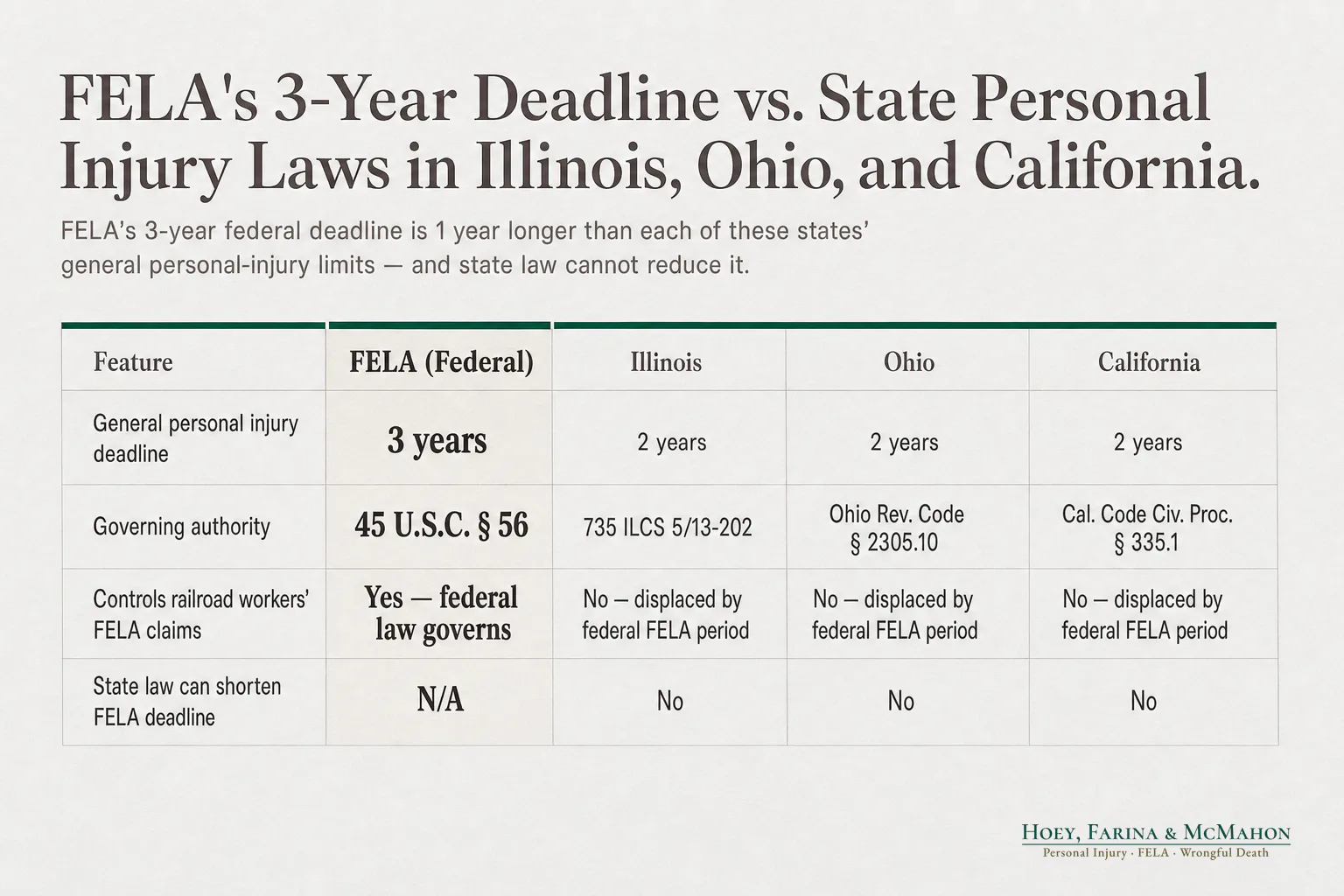
Many states like Illinois, Ohio and California allow only two years for injury claims (735 ILCS 5/13-202, Ohio Rev. Code § 2305.10, Cal. Code Civ. Proc. § 335.1), irrelevant to a FELA claim under section 56.
How the deadline works in state court
Section 56 gives state and federal courts concurrent jurisdiction, 28 U.S.C. § 1445(a) bars removal. Mondou v. New York, N.H. & H. R. Co., 223 U.S. 1 (1912), held state courts must hear these claims. Federal courts logged 310 FELA cases in fiscal 2025, down 5.5 percent from 328 and from 372 in 2021 (Table C-2A, Administrative Office of the U.S. Courts), excluding state-court filings. Venue changes procedure, not the deadline (filing a FELA lawsuit).
When the FELA Statute of Limitations Clock Actually Starts
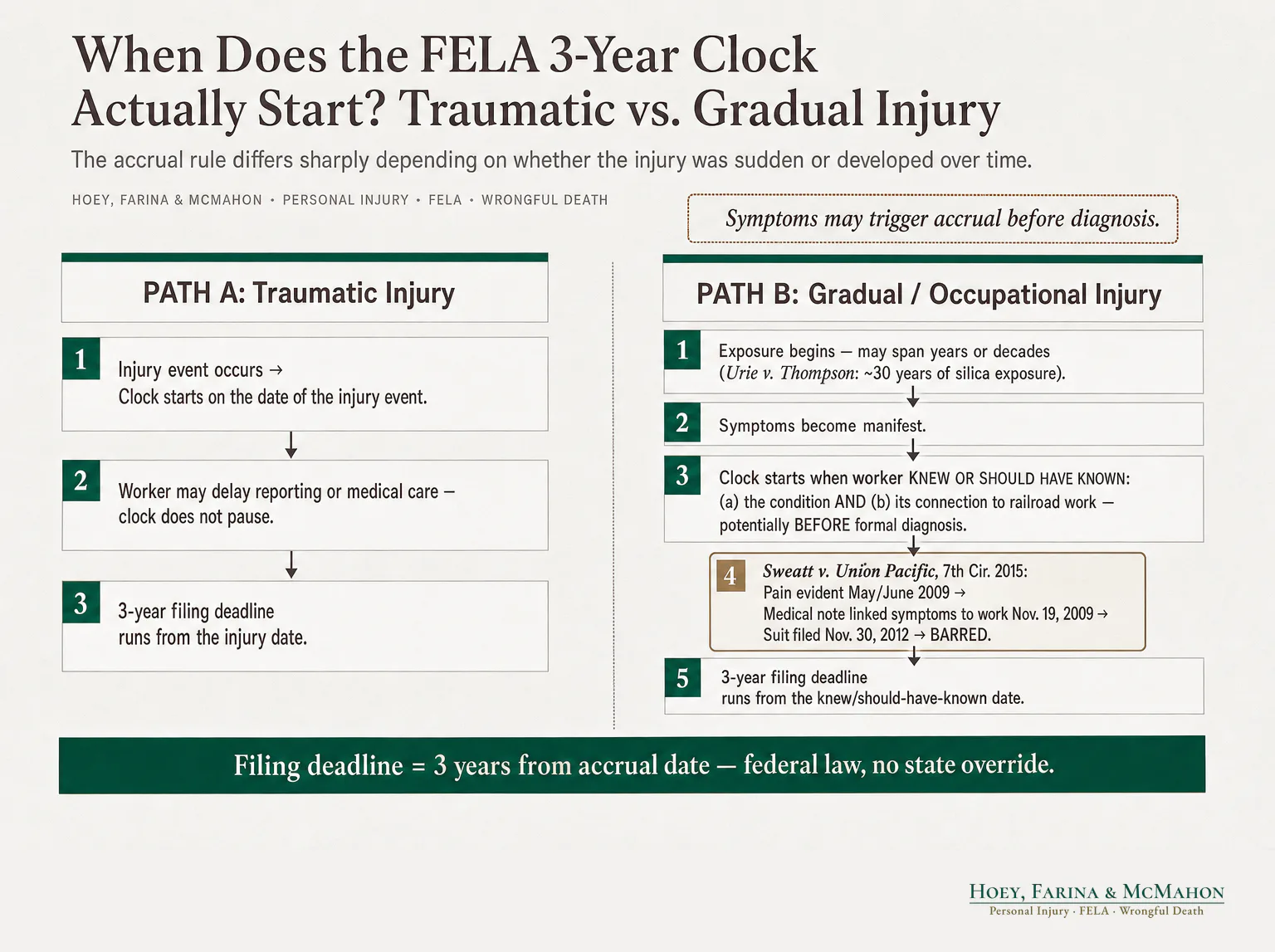
Accrual, not filing convenience, controls. Discrete accidents and gradually developing occupational injuries follow different accrual paths. The second is where most claims are lost.
The start date for a single traumatic accident
When injury and cause are immediately apparent, the three years begins on the accident date. Delayed reporting, a later diagnosis, or the first day of lost time does not move it. A claim involving unsafe equipment accrues the same way.
The discovery rule for occupational disease and repetitive trauma
Urie v. Thompson, 337 U.S. 163 (1949), involved roughly 30 years of silica exposure and rejected accrual at an unknowable early stage of silicosis, the "injurious consequences of the exposure are the product of a period of time, rather than a point of time." The clock starts when the worker knew or, with reasonable diligence, should have known of the injury and its likely work related cause, including hearing loss, cumulative trauma and hazardous materials exposure claims. In Sweatt v. Union Pacific Railroad Co., No. 14-2451 (7th Cir. Aug. 6, 2015), .
Why the railroad will fight over the start date
Railroads push accrual backward using prior medical records, earlier symptom complaints, and statements to claim agents. No formal diagnosis is required for the clock to run, so the three-year period may begin running before the worker has a confirmed medical opinion — making early legal advice and legal help critical to preserving the claim.
What Happens When a Railroad Worker Misses the FELA Deadline
Expiration is an affirmative defense, dismissal follows.
The narrow tolling exception
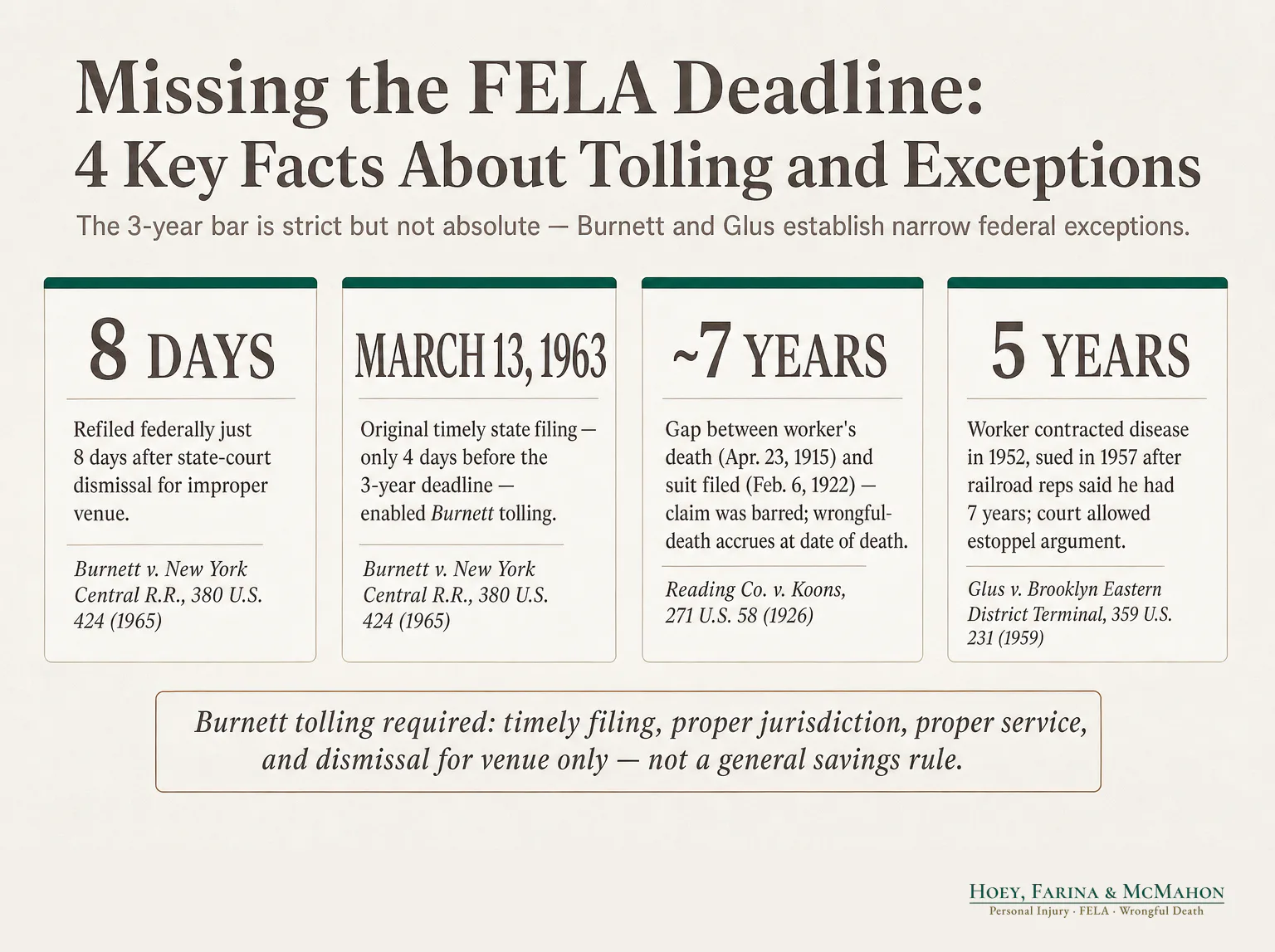
Burnett v. New York Central Railroad, 380 U.S. 424 (1965), a timely state suit dismissed for improper venue tolled the period, the limit is procedural, not substantive.
Wrongful death claims and the three-year rule
Reading Co. v. Koons, 271 U.S. 58 (1926), wrongful death accrues at death, not at estate opening, and the personal representative of the estate must file within that period.
Railroad Tactics That Can Erode the Remaining Time
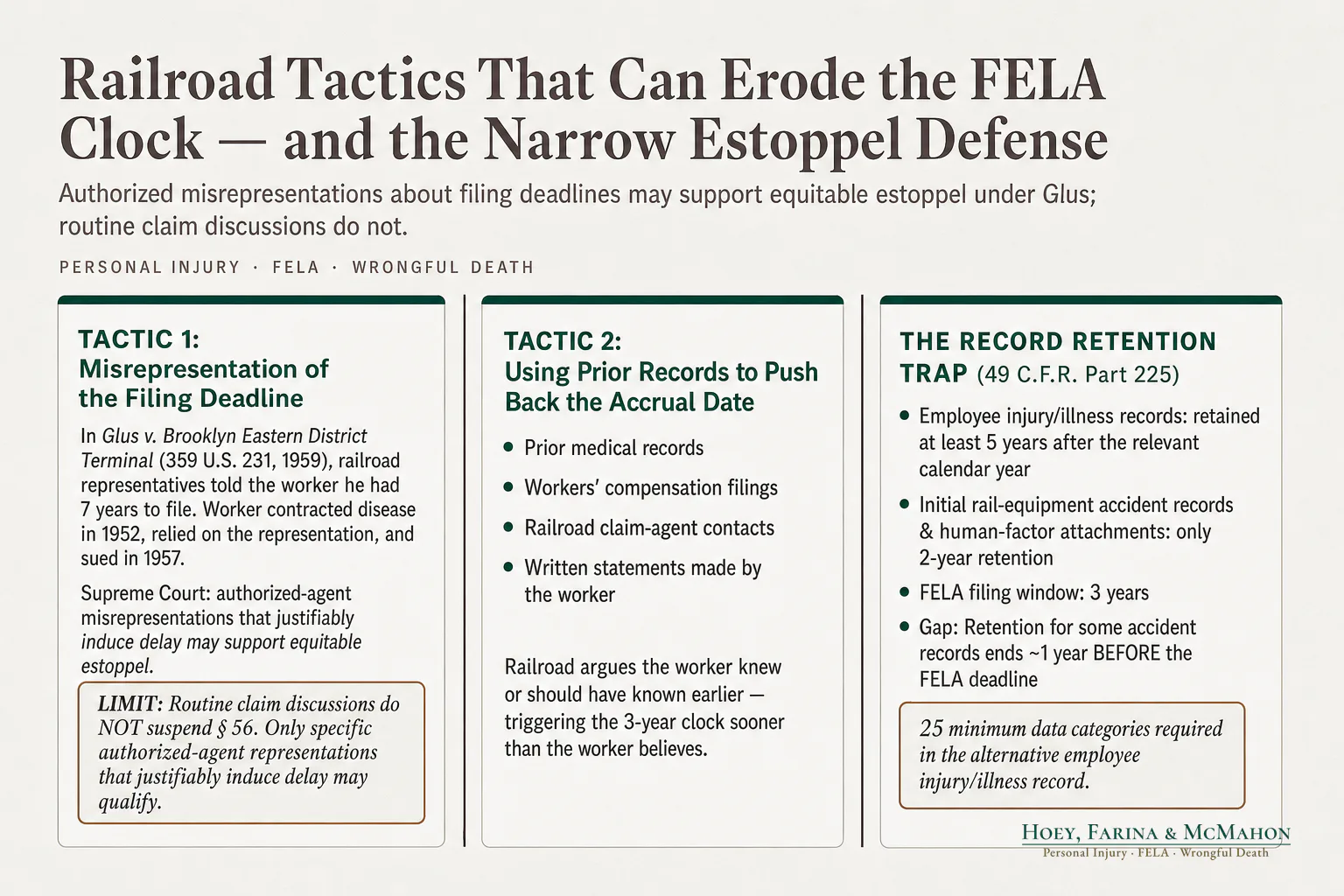
Railroads need not warn workers of the deadline, informal handling subtracts from the three years.
How claim agents consume the clock
A railroad claim agent may handle files, payments, and settlement talks for months, none of it tolls section 56. A worker two years into railroad injury settlements discussions may have weeks left.
Equitable estoppel for railroad-caused delay
In Glus v. Brooklyn Eastern District Terminal, 359 U.S. 231 (1959), railroad representatives told a worker with a 1952 occupational disease he had seven years to sue, he filed in 1957, and the Supreme Court let him prove estoppel. The doctrine reaches authorized representations inducing delay, not routine claim talks, and requires proven reliance — a successful claim on estoppel grounds is rare.
Evidence a Railroad Worker Should Preserve Before the Deadline Runs
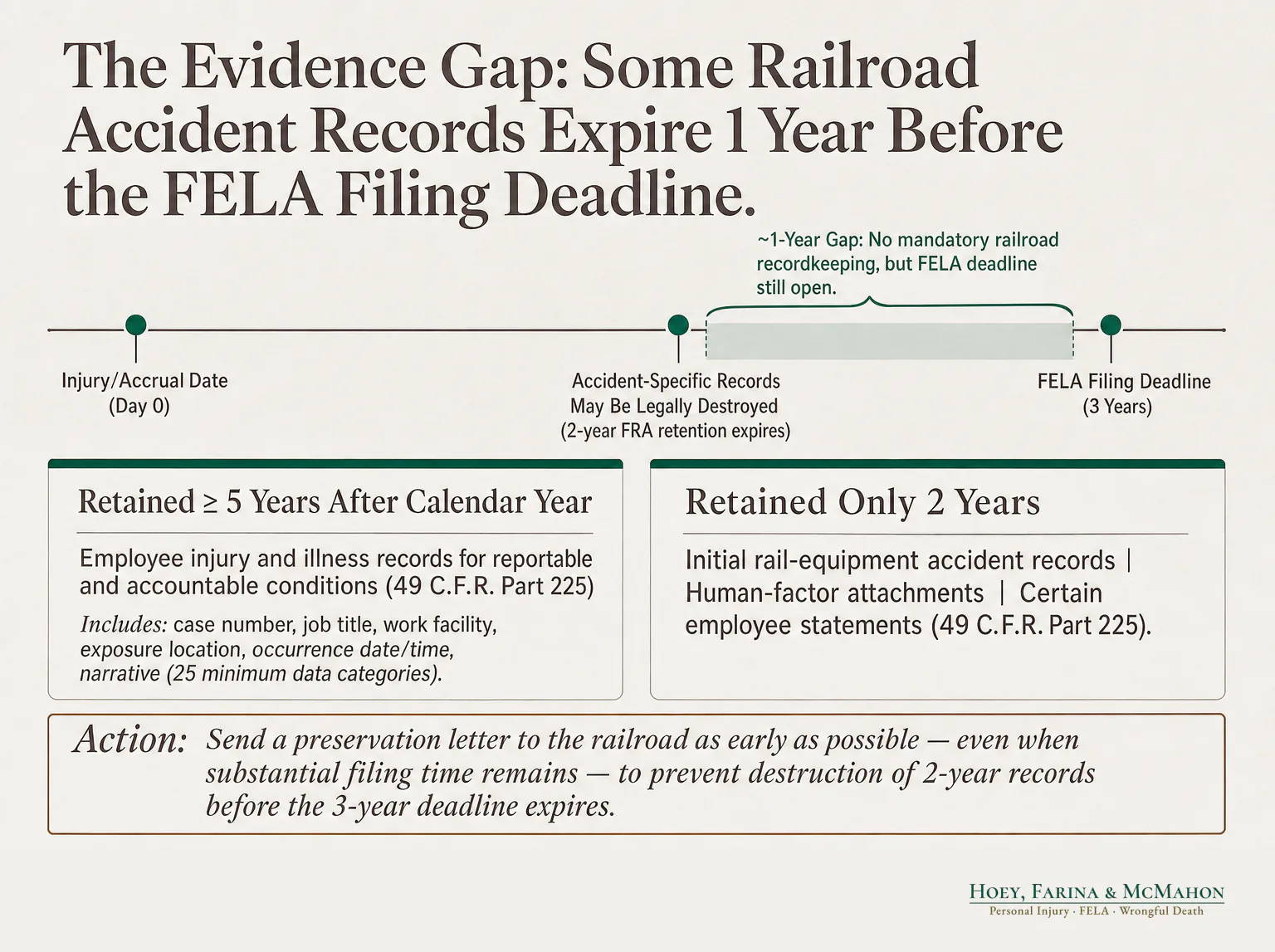
Preservation is a limitations issue as much as a proof issue, the same documents fix accrual and prove causation, and gaps in evidence can undermine a fela injury claim.
Medical and exposure records
Diagnosis records, physician notes, and opinions linking a condition to occupational exposure carry the injury claim. Job duties, work locations and exposure duration matter for cumulative trauma, and gaps in care create problems in claims involving delayed medical treatment.
Railroad injury reports and retention limits
Under 49 C.F.R. Part 225, covered railroads keep injury records, and § 225.25 requires 25 minimum data categories on the alternative record for illnesses claimed work-related. Section 225.27 generally requires five-year retention, but certain initial rail equipment accident records and employee statement supplements carry only two years. Retention can end about a year before the filing deadline, so send preservation demands early to protect fela claims.
Common Accrual and Deadline Questions Answered
Can a statute of limitations expire?
Yes. Once section 56's three years run, the railroad can defeat the claim, though Burnett and Glus allow narrow tolling and estoppel. Pursuing legal action before the deadline is the only reliable safeguard.
How far back can you claim personal injury?
It depends on the governing statute and on accrual, Illinois allows two years, FELA three, and gradual injury claims may accrue later under the discovery rule.
Can I claim for medical negligence after 20 years?
Ordinarily no. Illinois requires filing within two years of discovery and no later than four years after the act under 735 ILCS 5/13-212.
Do FELA-covered railroad workers use the workers' compensation system?
No. FELA is the exclusive remedy for railroad workers covered by the Act, and understanding legal rights under FELA is essential. Workers' compensation systems do not apply, see how an injured railroad worker recovers.
Can I file a FELA claim in state court and get a longer deadline?
No. State limitations statutes do not apply. The three-year federal period governs in every court.
What an Injured Railroad Worker Needs to Understand Before the Deadline Runs
The three-year fela statute of limitations runs from accrual, not from when a worker decides to act. With occupational disease and repetitive trauma, accrual is a contested fact question, and the railroad will argue the worker knew years earlier, making legal experience essential to a successful claim. Early advice about FELA rights and whether a FELA attorney is needed leaves more time to navigate the legal process and build the claim.
Hoey, Farina & McMahon, SMART-TD Designated Legal Counsel, offers a Free Case Evaluation to injured railroad workers and their families.
This article is provided for general information and is not legal advice. Reading it does not create an attorney client relationship. Legal outcomes depend on the facts of each case, and past results do not guarantee a similar outcome. If you were injured working on the railroad, discuss your situation with qualified counsel.
William J. McMahon Attorney & Managing Partner Hoey, Farina and McMahon