
How FRA Regulations Strengthen Your Railroad Injury Claim Under FELA
Key Takeaways
- Under 45 U.S.C. § 54a, chapter 201 FRA regulations count as statutes for §§ 53 and 54, reaching FELA's statutory violation rules.
- A contributing violation bars any negligence reduction (45 U.S.C. § 53).
- Causation is the worker's burden: any part, even the slightest.
- General code of operating rules isn't law; departure proves notice and chosen care standard, not negligence per se.
- Defective car tag copies kept only 90 days; demand preservation immediately.
*Written by William J. McMahon, Attorney & Managing Partner.* William J. McMahon is a trial attorney and partner at Hoey, Farina & McMahon in Chicago, representing injured railroad workers nationwide in FELA and FRSA cases. He is SMART-TD Designated Legal Counsel, a member of the Academy of Rail Labor Attorneys, and admitted to the United States Supreme Court and federal district courts across ten states. His verdicts include $10 million and $2.3 million for injured railroaders, the firm's record includes a $33 million FELA verdict, and Leading Lawyers named him a Top Ten FELA attorney in Illinois in 2021 and 2022.
By William J. McMahon, Attorney and Managing Partner, Hoey, Farina & McMahon. The firm handles Federal Employers Liability Act litigation nationwide.
A railroad worker who proves a violation of FRA regulations often does not have to prove the railroad was careless. Where the violated provision creates an applicable federal safety duty, the breach itself supplies fault, and the railroad's evidence about how reasonably it normally operates loses much of its force. This article explains which rules in 49 CFR matter most, how CSX Transportation, Inc. v. McBride controls the causation instruction in a Federal Employers' Liability Act (FELA) case, and how U.S. Department of Transportation railroad safety enforcement procedures shape what the railroad will still argue.
What FRA Regulations Are and Why They Govern Railroad Worker Safety
FRA regulations are binding federal safety rules and enforced by the U.S. Department of Transportation's Federal Railroad Administration through inspections and civil penalties. Any railroad claim turns on the provision that applied that day.
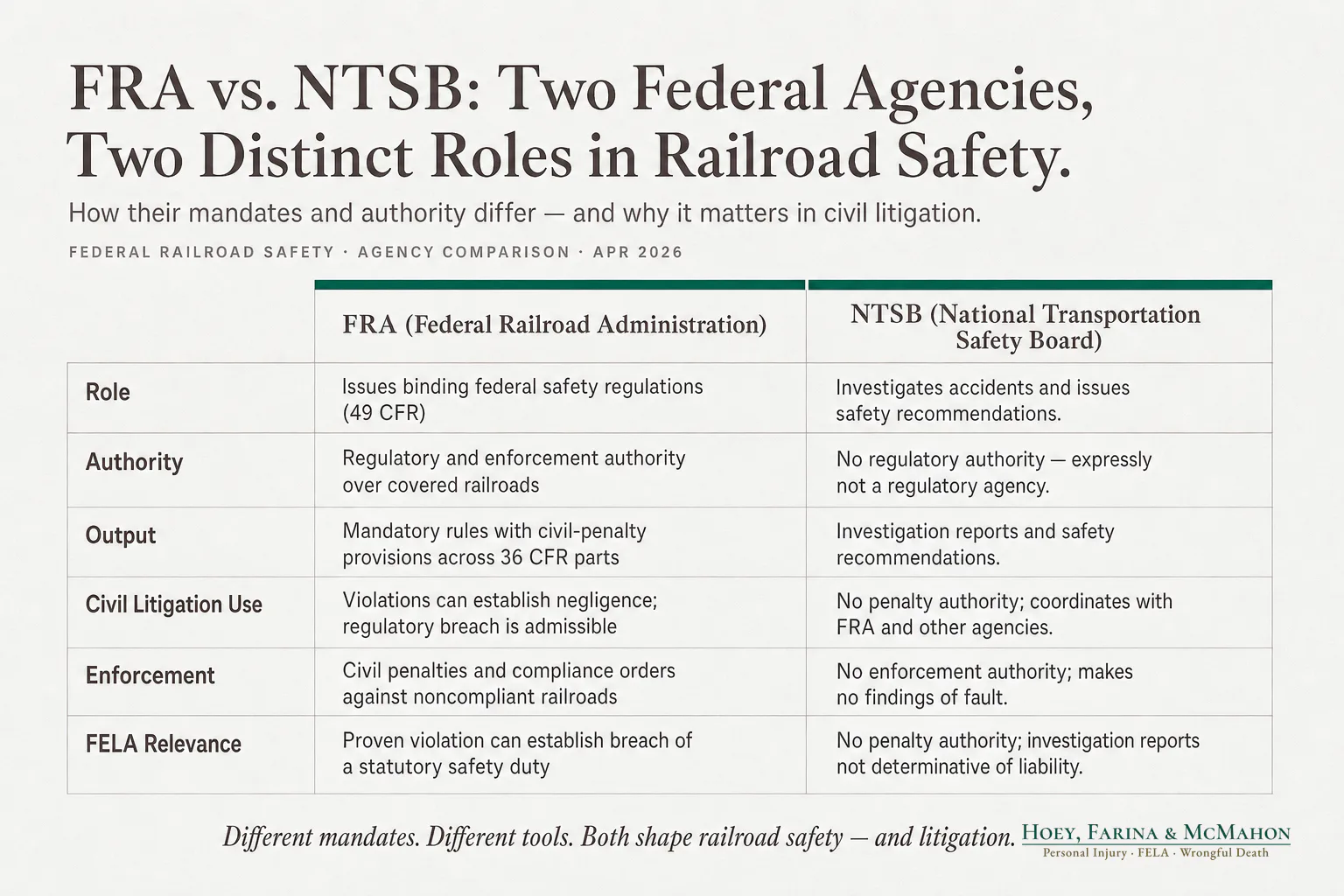
The Federal Railroad Administration's authority under 49 CFR
49 CFR parts carry railroad safety civil penalty provisions covering track, equipment, signal and train control, roadway worker protection, hours of service, and passenger train emergency preparedness.
How the National Transportation Safety Board fits into investigations
NTSB investigates accidents but writes no rules. Under 49 U.S.C. § 1154(b), no part of a Board report is admissible in a civil damages action. Its public docket still points counsel to original source evidence.
How FELA Uses FRA Violations to Shift the Causation Burden
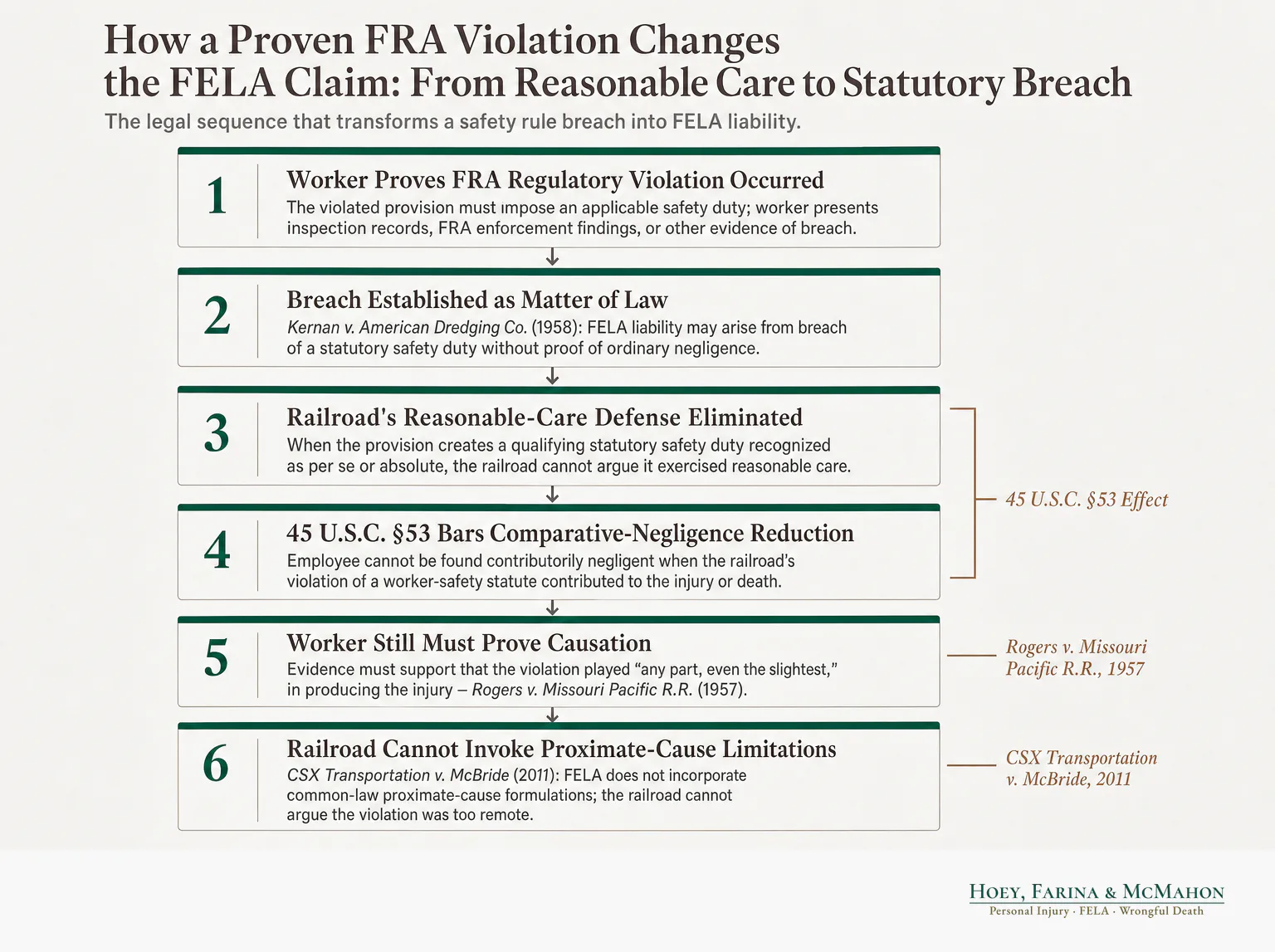
A qualifying FRA violation turns a FELA railroad injury claim into statutory breach, a principle that CSX Transportation Inc v McBride confirmed by rejecting the proximate cause standard.
Negligence per se and the loss of the comparative fault defense
Kernan v. American Dredging Co., 355 U.S. 426 (1958), allows liability for a statutory safety breach contributing to the injury, 45 U.S.C. § 53 bars any contributory negligence reduction where a violation of a statute enacted for the safety of employees contributed to the injury, erasing the comparative fault reduction, and 45 U.S.C. § 54a covers chapter 201 regulations.
What the relaxed causation standard still requires
Rogers v. Missouri Pacific Railroad, 352 U.S. 500 (1957), sets the test: employer fault need only play any part, even the slightest, a burden the worker still bears.
What CSX Transportation v. McBride Means for FRA Violation Claims
CSX Transportation, Inc. v. McBride, 564 U.S. 685 (2011), held that FELA rejects common law proximate cause, juries ask only whether railroad negligence played any part, however small. The fra railroad safety board argument for a stricter standard was squarely rejected.
The question before the Court
CSX sought a stricter proximate cause instruction, the Court refused, holding that FELA dispenses with the common-law proximate cause requirement entirely. McBride's $275,000 award was cut one third for contributory negligence, a cut § 53 bars after a qualifying violation.
Where the railroad still fights
Causation. In Huffman v. Union Pacific Railroad, the Fifth Circuit vacated a $606,000 verdict absent proof tying ergonomic negligence to knee osteoarthritis, medical causation decides these claims, from shoulder injury to cumulative trauma.
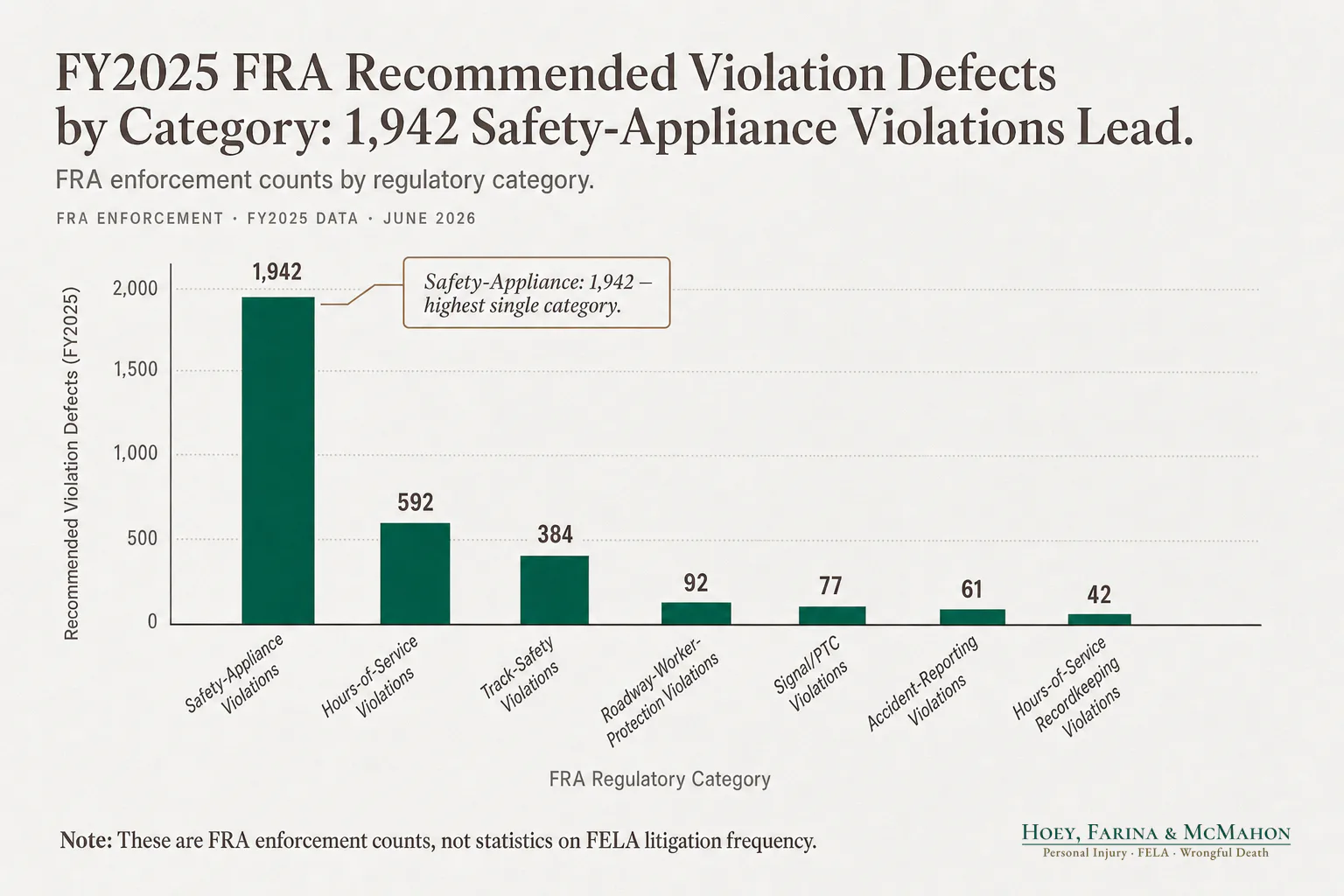
Which FRA Regulations Most Often Appear in Railroad Injury Claims
Track, equipment, operating practices and hours of service rules dominate FELA cases.
Track and freight car standards under Parts 213 and 215
Part 213 requires weekly inspection of excepted and Class 1 through 3 main track, at least three calendar days apart, excepted track caps speed at 10 mph and bars occupied passenger trains. Part 215 bars freight cars with listed defects and requires inspection before each departure, key in defective equipment and train accident claims.
Hours of service and train control requirements
49 U.S.C. § 21103 caps train employees engaged in or connected with the movement of a train at 12 consecutive hours on duty, with 10 consecutive hours prior rest and a 276 hour monthly aggregate. Positive train control covered all 57,536 required route miles by December 29, 2020, so claims turn on operation, maintenance, interoperability, outages or improper disabling, as do FRA cell phone rules violations.
How the Railroad General Code of Operating Rules (GCOR) Interacts With FRA Standards
The railroad General Code of Operating Rules (GCOR) is an industry rulebook, not a federal regulation issued through railroad safety enforcement procedures, so departure is always not negligence per se.
The legal weight a GCOR violation carries
A GCOR provision reflects the railroad's own safety standard, departure evidences breach, notice and foreseeability, as in Amtrak accident liability claims.
Pleading both in the same claim
One act can breach both 49 CFR and GCOR, the regulation supplies the statutory duty, the GCOR departure corroborates breach and notice.
What Railroad Accident Investigation Records Reveal About FRA Compliance
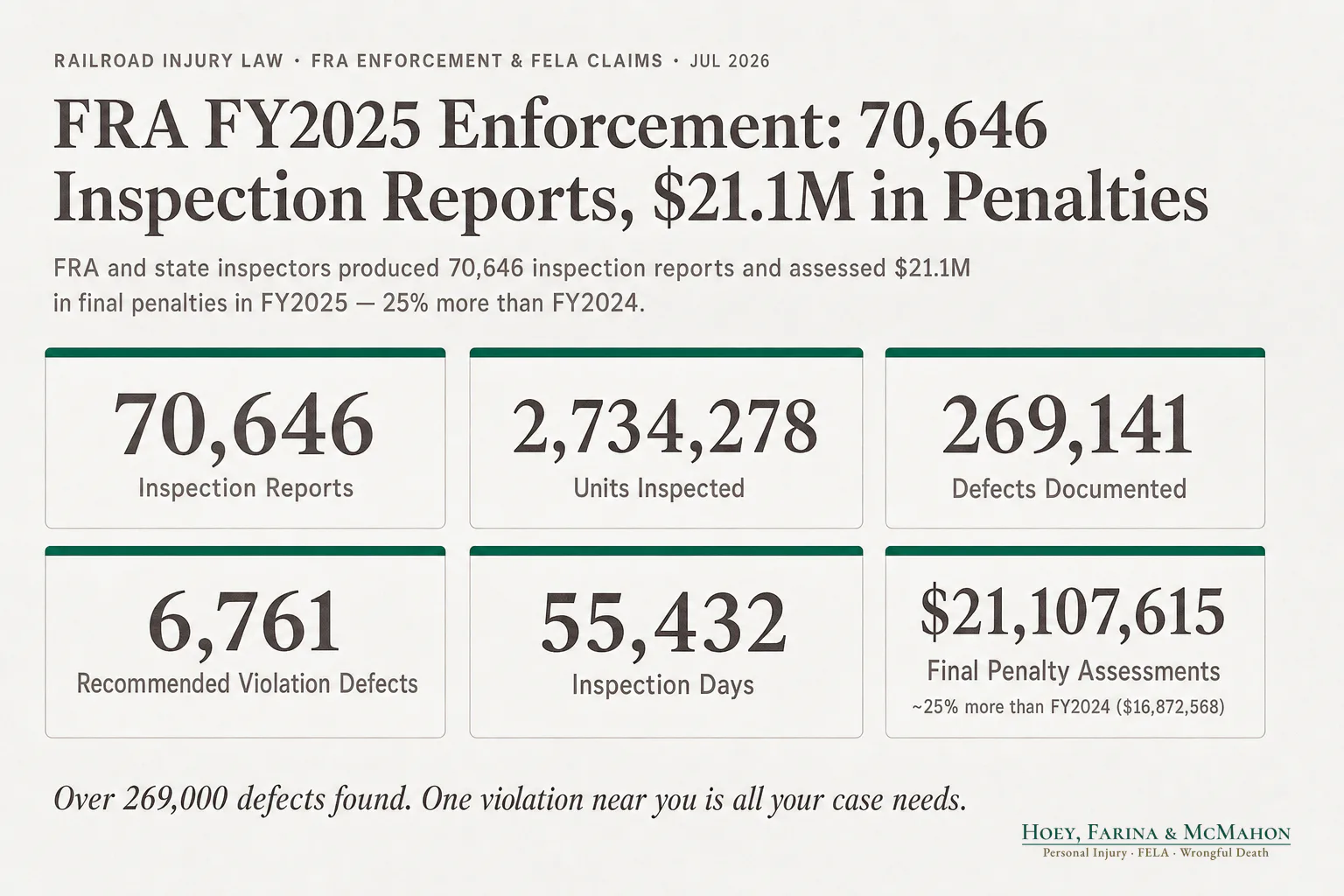
The U.S. Department of Transportation's FRA FY2025 enforcement report documents 70,646 inspections and 269,141 defects, and FRA issued more than $21 million in civil penalties, with rail safety fines 25 percent above FY2024.
What Part 225 requires and what it does not prove
Part 225 filings record facts, not FRA violation findings, and railroad safety enforcement procedures under 49 U.S.C. § 20903 limit their use in civil damages actions. Disputed liability after a collision needs discovery.
Accountable records and the internal file
Accountable injuries exceed reportable ones under a more likely than not test, not Rogers, no report disproves a FELA claim. Safety related railroad employees who face retaliation for reporting injuries may support an FRSA whistleblower claim.
Frequently Asked Questions
What is FRA compliance?
FRA regulations require meeting the statutes, orders and recordkeeping rules that apply to a given operation, identified case by case because waivers exist, and compliance applies to all safety related railroad employees covered by those provisions.
What are FRA requirements?
Minimum 49 CFR standards for track, equipment, roadway worker protection, accident reporting, signal and train control, hours of service and Part 239 passenger train emergency preparedness.
What are FRA rules?
Binding U.S. Department of Transportation Federal Railroad Administration regulations. A violation is strong FELA evidence, and a qualifying safety duty establishes fault without proof of unreasonable care.
What is FRA reportable?
Events meeting the § 225.19 thresholds, treatment beyond first aid, significant diagnosed injury, lost consciousness, days away, restricted work or job transfer.
What to Preserve and What to Expect After a Railroad Injury
A qualifying breach of a federal safety statute or incorporated FRA regulation that contributed to the injury establishes negligence as a matter of law and, under § 53, prevents any comparative fault reduction, though the railroad keeps its other defenses and the worker still bears the burden of proving causation under Rogers and CSX Transportation, Inc. v. McBride.
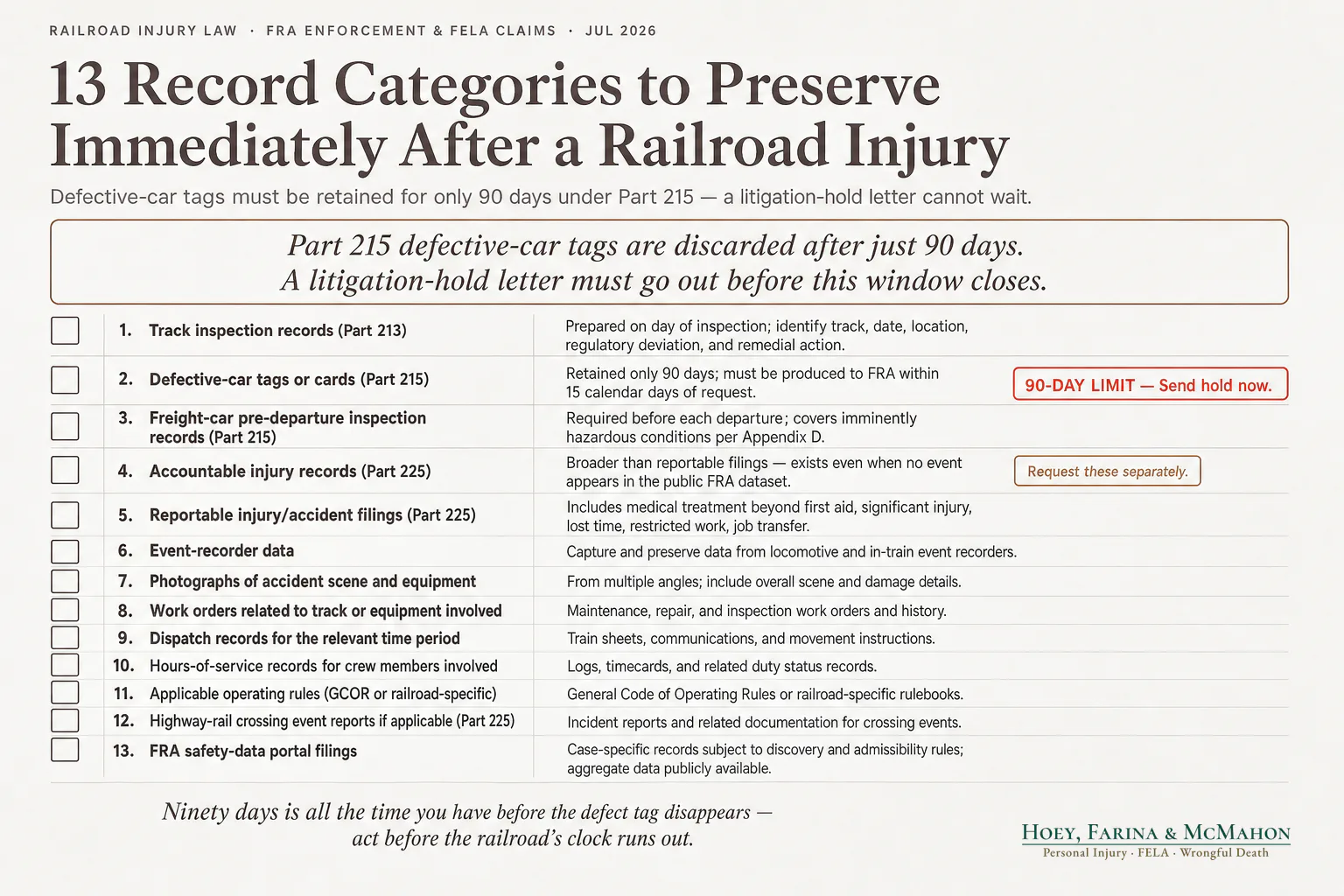
Defect tag records need only be kept 90 days under 49 CFR § 215.9, track inspection records are made the day of inspection.
Request a free case evaluation and demand inspection reports, event recorder data and hours of service records before the clocks run out.
This article is provided for general information and is not legal advice. Reading it does not create an attorney client relationship. Legal outcomes depend on the facts of each case, and past results do not guarantee a similar outcome. If you were injured working on the railroad, discuss your situation with qualified counsel.
William J. McMahon Attorney & Managing Partner Hoey, Farina and McMahon