
Why Injured Railroad Workers Need a Railroad Attorney Who Knows FELA
Key Takeaways
- Why FELA is nothing like workers' comp
- What you must prove to win a FELA claim
- How the railroad builds its defense against you
- Why a general PI lawyer isn't enough for FELA
- Damages, deadlines, and what your claim may recover
- What happens when you contact the firm
Written by William J. McMahon, Attorney & Managing Partner. William J. McMahon is a trial attorney and partner at Hoey, Farina & McMahon in Chicago, representing injured railroad workers nationwide in FELA and FRSA cases. He is SMART-TD Designated Legal Counsel, a member of the Academy of Rail Labor Attorneys, and admitted to the United States Supreme Court and federal district courts across ten states. His verdicts include $10 million and $2.3 million for injured railroaders, the firm's record includes a $33 million FELA verdict, and Leading Lawyers named him a Top Ten FELA attorney in Illinois in 2021 and 2022.
Railroad workers hurt on the job do not file a workers' compensation claim. Since 1908, their remedy has been the Federal Employers' Liability Act, a federal statute — also written as the federal employers liability act — that lets a railroad worker sue the railroad for negligence. That single difference changes what must be proved, what can be recovered, and who is already working against the claim. The railroad's claim agents and defense counsel begin evaluating an injury almost immediately. A railroad attorney who works in FELA every day reads those first days very differently than a lawyer who mostly handles car crashes.
Five Rules That Govern Every FELA Claim
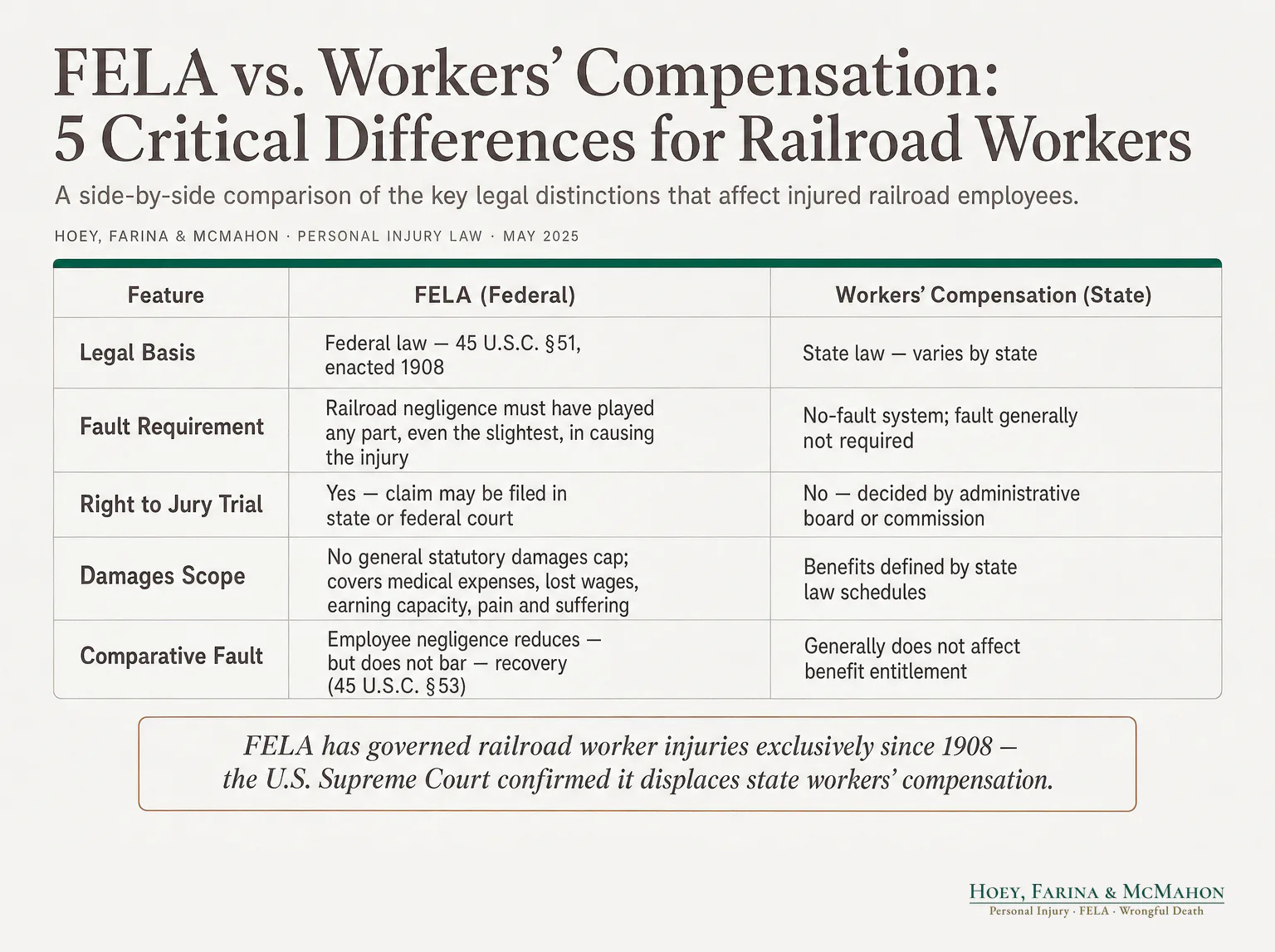
FELA is based on fault, not no fault. Railroad negligence must have played some part in the injury, and under Rogers v. Missouri Pacific Railroad that part can be slight. Railroads routinely argue that a worker's own conduct was the sole or dominant cause — but under Rogers, even a slight contribution by the railroad is enough to reach the jury. A worker who accepts the railroad's framing of fault early in the process risks losing leverage that the law actually preserves.
Your own share of fault reduces a FELA award but does not bar it. Under 45 U.S.C. § 53, comparative fault only proportionally reduces damages — it does not eliminate the claim. Railroads push for the highest fault percentage they can support, and that reduction disappears entirely when a qualifying safety statute violation contributed to the injury. Workers who do not understand this distinction may accept a settlement that discounts their recovery far more than the law requires.
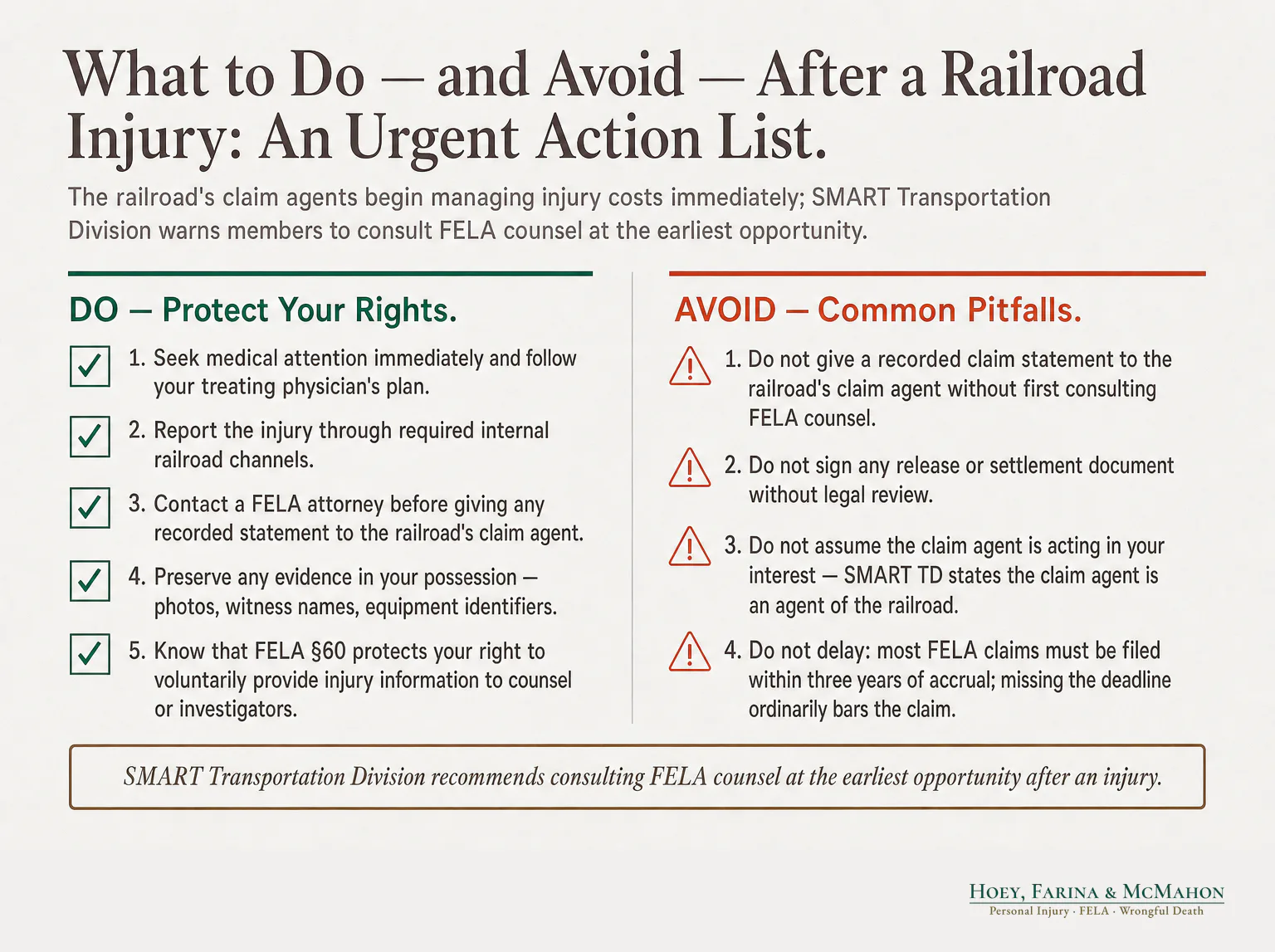
A claim agent works for the railroad. Their job is to evaluate and limit the railroad's exposure, not to protect your interests. Talk with a railroad attorney before giving a recorded statement or signing a release — early statements can later be used to dispute fault, causation, or the extent of your injury.
Most FELA actions must be commenced within three years of accrual under 45 U.S.C. § 56. Railroads sometimes argue that the clock started earlier than a worker realizes, particularly in occupational disease cases where exposure was gradual. Occupational disease claims raise harder accrual questions, and waiting to consult counsel can foreclose options that would otherwise be available.
Choose counsel with demonstrable railroad and FELA experience rather than assuming general personal injury experience carries over. FELA is a federal statute governed by federal decisional law, and its causation standard, comparative fault rules, and safety statute provisions diverge from ordinary tort practice in ways that matter at every stage of a claim.
Railroad Workers Are Covered by a Federal Law, Not Workers' Compensation
If you work for an interstate railroad, FELA governs your injury remedy, not state workers' compensation. The Supreme Court held in 1917 that FELA regulates the subject "inclusively and exclusively" (Library of Congress). BLS counted about 149,700 rail transportation employees in June 2026 and 3.4 cases per 100 full-time workers in 2024. Injury pay follows negligence law, not a benefits schedule.
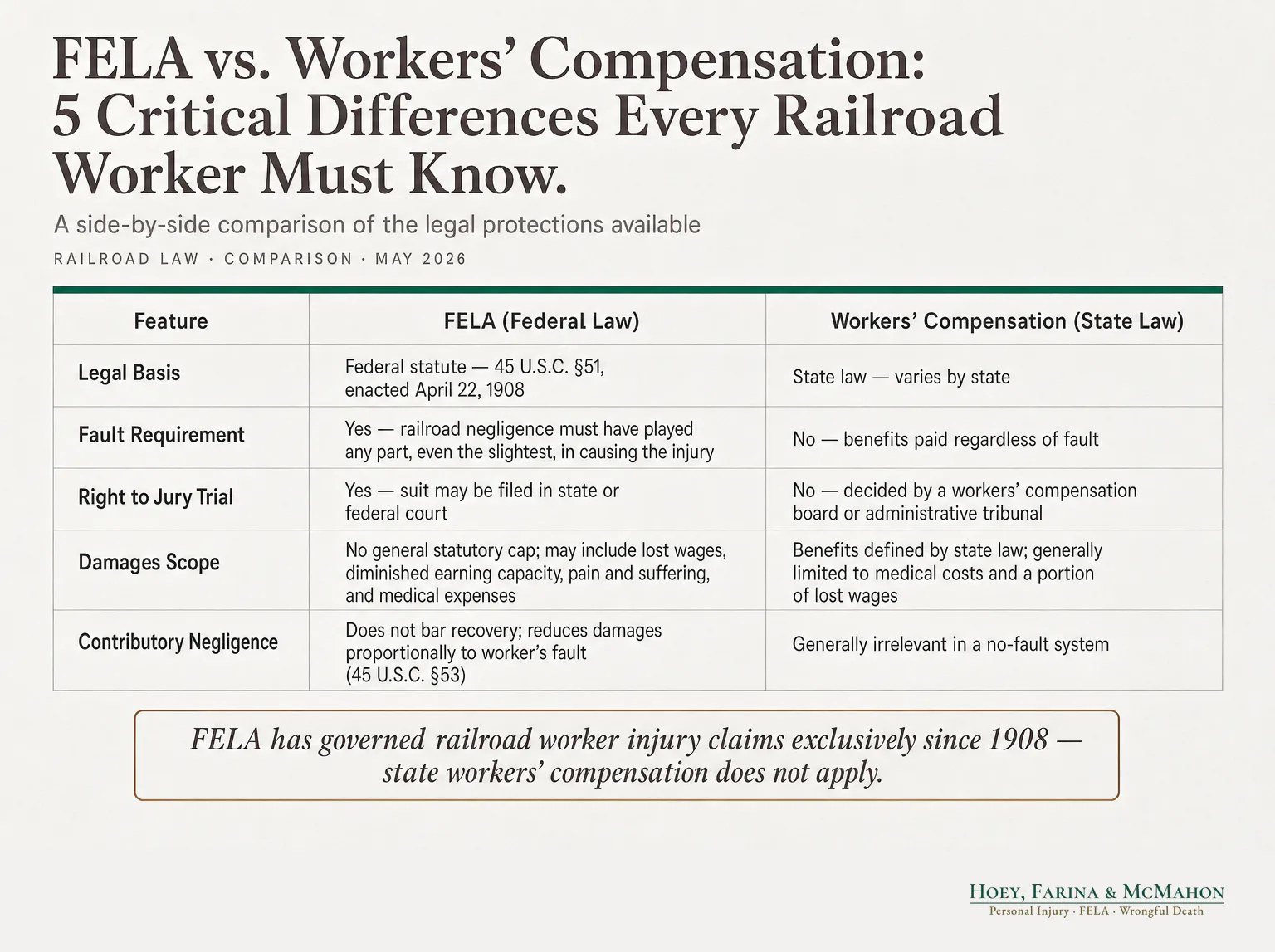
- Issue: Fault. FELA: negligence must be proved. State workers' compensation: generally no fault.
- Issue: Forum. FELA: state or federal court, jury. State workers' compensation: administrative agency.
- Issue: Damages. FELA: no statutory cap. State workers' compensation: set by state law.
Who Qualifies Under 45 U.S.C. § 51
Coverage reaches employees of interstate railroads whose duties further, or directly and substantially affect, that commerce (U.S. Code). Engineers, conductors, carmen, signal and maintenance of way workers commonly qualify, contractor status needs separate analysis.
What an Injured Railroad Worker Must Prove to Win a FELA Claim
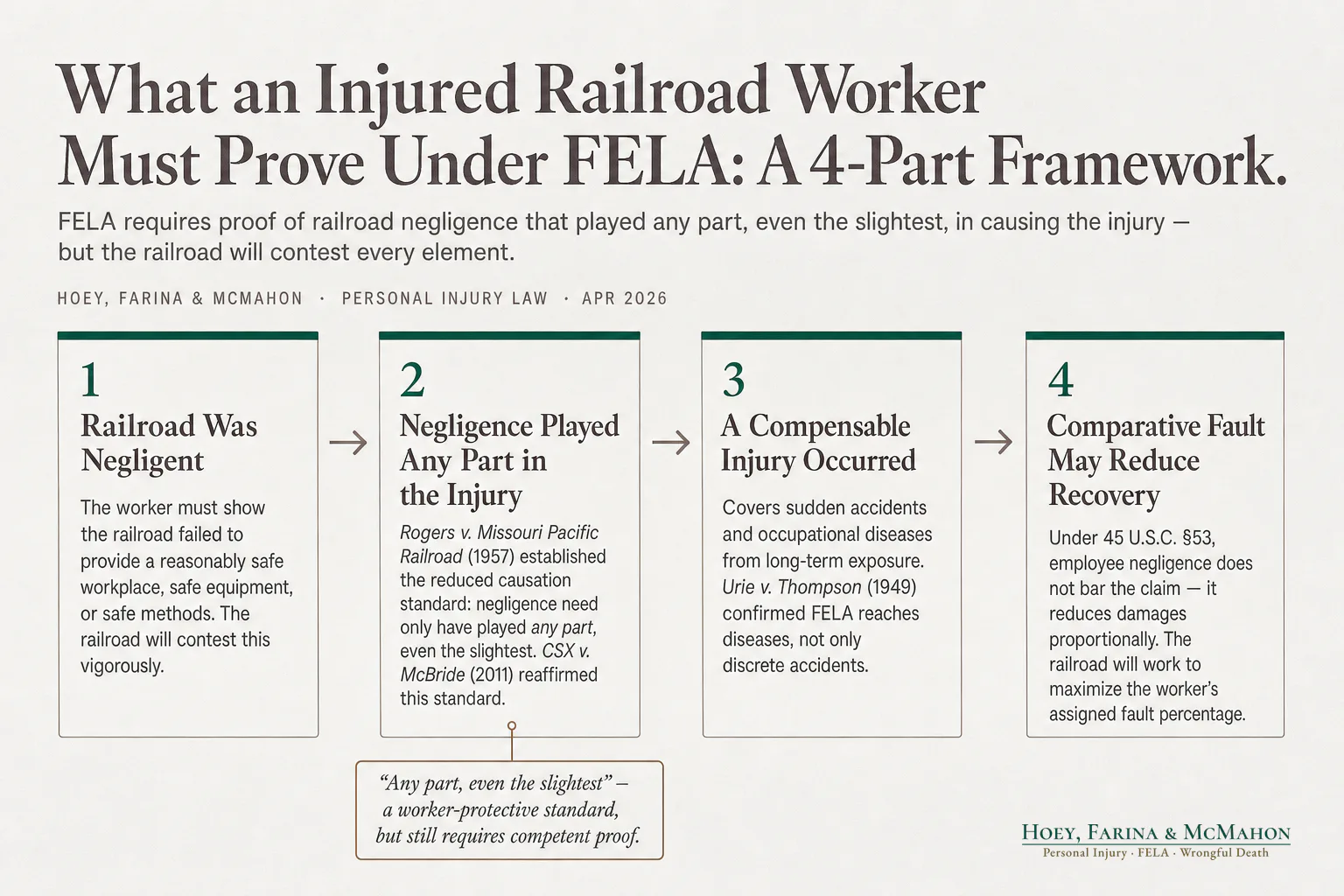
FELA does not pay automatically. A worker must prove four elements, duty, negligent breach, causation, and damages.
The Causation Standard Is Reduced, Not Eliminated
Rogers v. Missouri Pacific Railroad (1957) asks whether railroad negligence played "any part, even the slightest" in producing the injury, though jurors must still find negligence (Library of Congress). CSX Transportation v. McBride (2011) reaffirmed that ordinary proximate cause language does not control.
What Your Own Fault Does and Does Not Do
Under 45 U.S.C. § 53, a worker's negligence reduces damages proportionally instead of barring recovery, and it is no defense where a safety statute violation contributed to the injury. Railroads still push for the largest fault percentage they can support.
The Railroad Starts Building Its Defense the Moment You Are Hurt
A claim agent works for the railroad, and the SMART Transportation Division urges members to seek FELA counsel immediately (SMART-TD). Early statements or releases can later be used to dispute fault, causation or injury extent.
Talk With Counsel Before Signing Anything
Report the injury as your work rules require, then get advice before signing anything.
Evidence Sits in the Railroad's Hands
Event recorder downloads, dispatch and inspection records and crew statements can be overwritten, so counsel demands preservation early. FELA Section 60 voids rules blocking workers from voluntarily furnishing injury information, with fines up to $1,000, imprisonment up to one year, or both (U.S. Code).
Why a General Personal Injury Lawyer Is the Wrong Choice for a FELA Claim
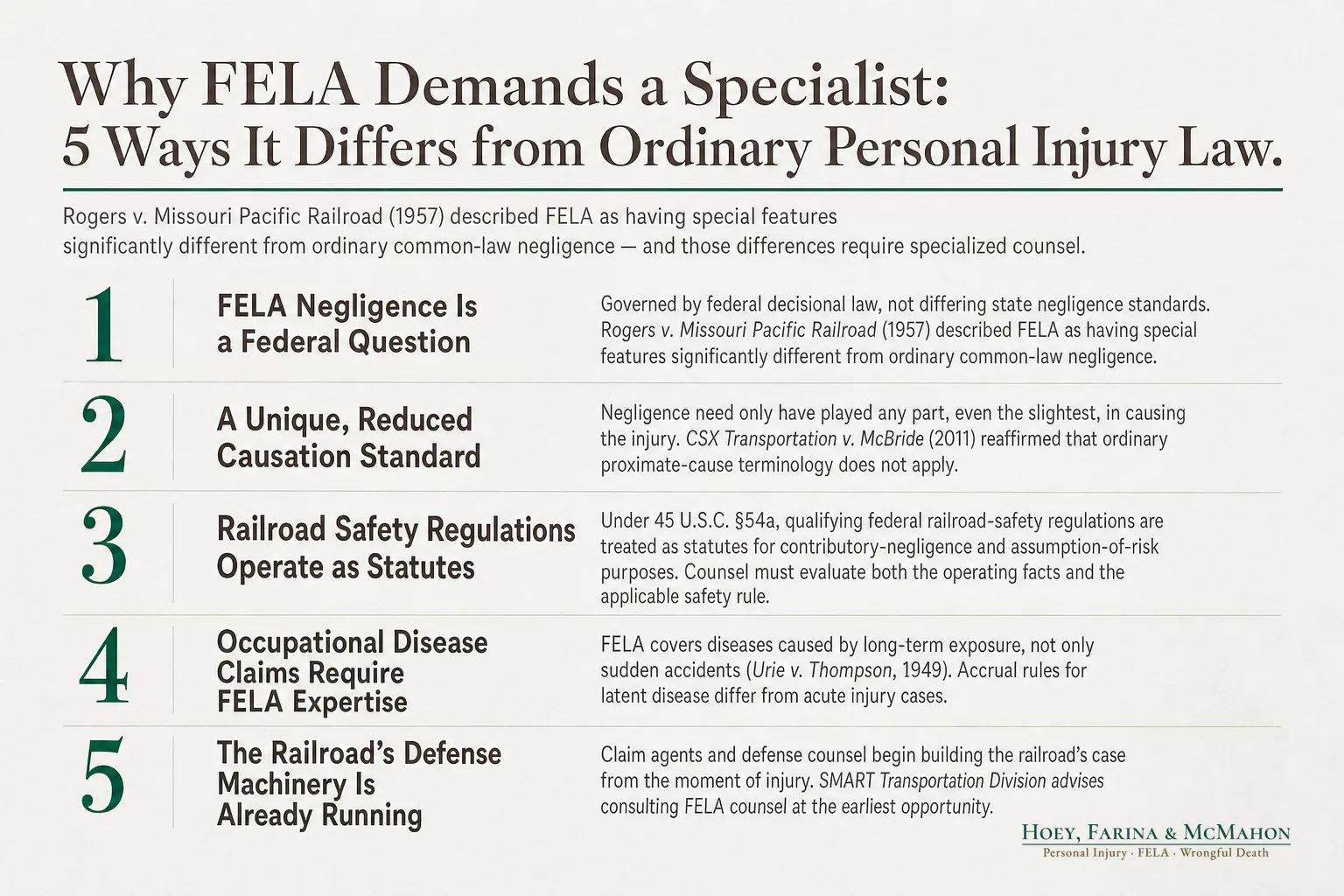
The issue is focus, not competence. FELA negligence is a federal question governed by federal decisional law, and courts applying Rogers and later Supreme Court decisions have recognized special features of FELA that ordinary tort practice never encounters. Asking whether you need FELA counsel is fair early.
Five Places FELA Diverges From Ordinary Tort Practice
Three distinctions matter most in practice. First, causation: Rogers v. Missouri Pacific Railroad asked whether the standard from ordinary negligence law — proximate cause — should govern FELA claims. The Court rejected it, adopting a "any part, even the slightest" test that shifts the burden of proof in a meaningful way; a worker no longer has to show the railroad's negligence was the dominant cause, only that it played some role. Second, comparative fault: unlike contributory negligence jurisdictions that bar recovery entirely, FELA's Section 53 only reduces the award proportionally — and that reduction disappears when a qualifying safety statute violation contributed to the injury, removing the railroad's most common defense. Third, the nondelegable duty of a reasonably safe workplace means the railroad cannot escape liability by blaming a contractor or co-worker; the obligation runs directly to the injured worker and cannot be delegated away.
Safety Rules Change the Defenses Available
Section 54a treats qualifying FRA regulations and participating state requirements as statutes under FELA's contributory negligence and assumption of risk provisions, routine in a railroad claim, unfamiliar in a general practice.
Which Railroad Injury Claims Fall Under FELA
Railroad FELA cases include trauma, occupational disease, defective equipment, wrongful death, and retaliation. All are based on fault.
Traumatic Injury, Occupational Disease and Wrongful Death
Urie v. Thompson (1949) applied FELA to occupational disease, silicosis from 30 years of sand exposure at 80 to 90 percent silica (Library of Congress). Section 51 covers negligent death.
FRSA Retaliation After an Injury Report
FRSA protects good faith injury reports, safety complaints and medical care requests. OSHA deadline: 180 days, punitive damages capped at $250,000 (eCFR). Election of remedies requires coordinating injury and whistleblower claims.
What a FELA Claim May Recover and How Long You Have to File
FELA covers medical expenses, lost earnings, lost earning capacity, pain and suffering, and property damage where applicable, with no compensatory cap. Awards are reduced by comparative fault. In Norfolk & Western Railway v. Ayers (2003), the Court compensated an asbestosis claimant's genuine fear of cancer. See the full range of FELA damages and railroad injury settlements.
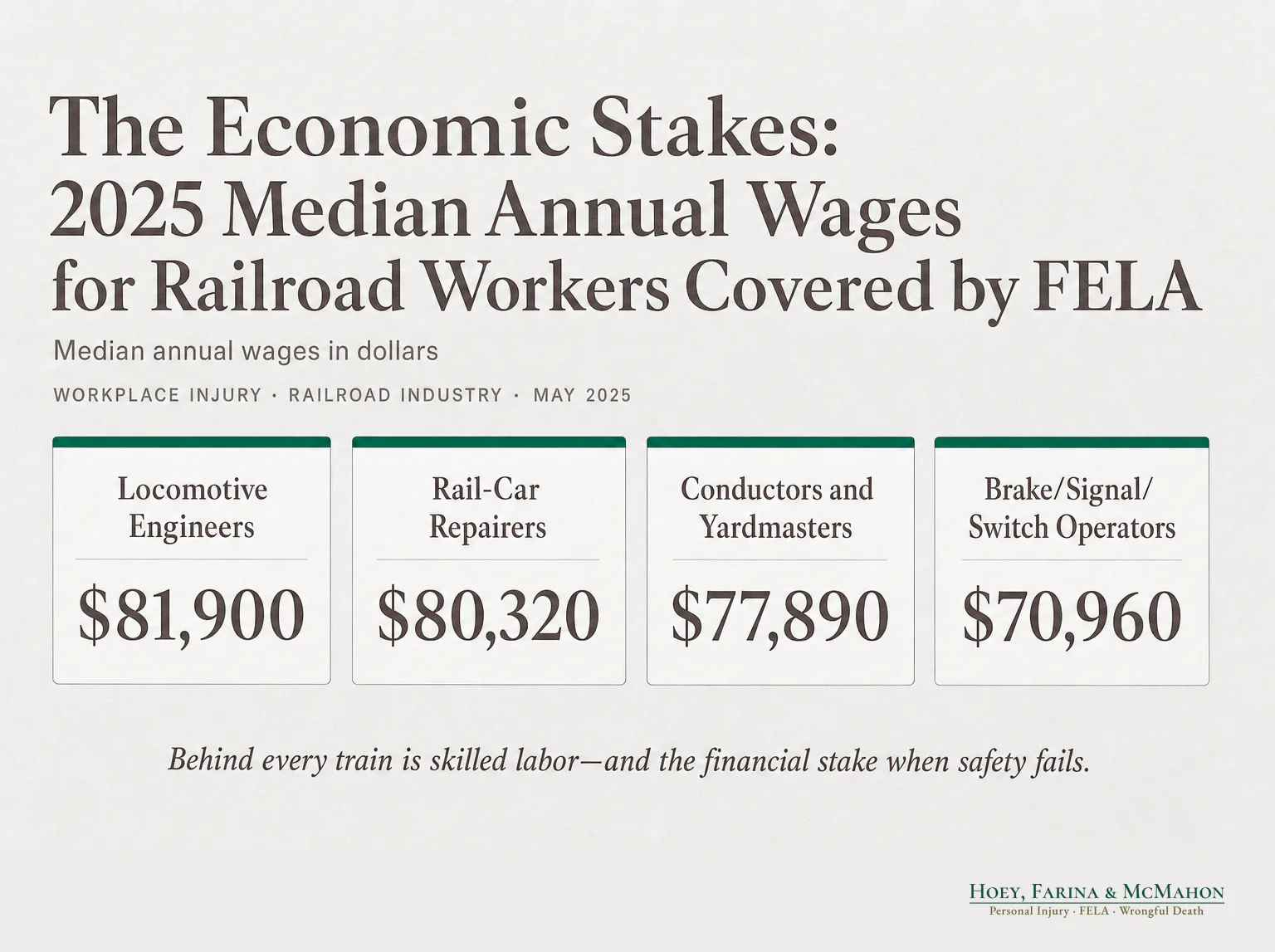
Lost Earning Capacity Is Often the Largest Number
BLS 2025 median annual wages: $81,900 locomotive engineers, $80,320 rail car repairers, $77,890 conductors and yardmasters, $70,960 brake, signal and switch operators (BLS). Career ending injuries explain why railroads fight causation.
Three Years From Accrual
Section 56 requires suit within three years of accrual (U.S. Code), extended from two years in 1939. For latent disease, Urie ties accrual to when the accumulated effects of exposure manifest themselves, and later decisions such as Fries v. Chicago & Northwestern Transportation Co. refined that into a discovery rule requiring knowledge of both the injury and its cause [citation to reporter, court, and year to be verified by attorney before publication].
What to Expect When You Contact Hoey, Farina and McMahon
A free case evaluation carries no obligation. The firm assesses whether a Federal Employers' Liability Act claim is viable, and the role FELA counsel plays is investigation, proof and negotiation.
Fees and Filing Location
Fee terms are explained in writing upfront. FELA permits filing in qualifying state or federal courts and forums, though Section 56 is a venue provision, not a grant of personal jurisdiction, after BNSF Railway v. Tyrrell (2017), both are evaluated case by case.
Union Members and Railroad Workers Beyond Illinois
SMART-TD's directory lists William J. McMahon as SMART-TD Designated Legal Counsel (SMART-TD).
Frequently Asked Questions About Hiring a Railroad Attorney
What is a railroad lawyer?
A lawyer who represents railroad workers in FELA injury and FRSA retaliation claims under specialized federal law.
Can I file a FELA claim if I was partly at fault?
Yes. Section 53 reduces damages by your fault share rather than barring the claim, and Section 53's comparative fault reduction does not apply where a qualifying safety statute violation contributed to the injury.
The claim agent already called me. What now?
Meet your reporting duties, then call a railroad attorney before giving a recorded statement or signing a release.
Is it worth pursuing pain and suffering damages?
FELA allows noneconomic damages that state benefit systems do not pay. Value depends on evidence, injury severity, and fault. No particular result is assured.
Can I hire a railroad attorney outside my state?
Often yes, railroad counsel handle FELA cases in other states via local admission or pro hac vice.
Taking the Next Step After a Railroad Injury
FELA's standards diverge from ordinary tort practice in ways that matter at every stage of a claim, which is why the law rewards workers who retain a railroad attorney who works in it daily. The railroad's investigation is already underway, records may be overwritten, and the three-year clock runs whether or not you file. A railroad attorney adds early evidence preservation and the proof needed to answer the comparative fault argument the railroad has been building since your injury.
William J. McMahon is an attorney and Managing Partner at Hoey, Farina & McMahon, P.C., and is listed as SMART-TD Designated Legal Counsel. This page is general information, not legal advice, and does not create an attorney client relationship. Outcomes depend on the facts of each case; prior results do not guarantee a similar outcome. If you were injured on the railroad, discuss your situation with qualified counsel.
This article is provided for general information and is not legal advice. Reading it does not create an attorney client relationship. Legal outcomes depend on the facts of each case, and past results do not guarantee a similar outcome. If you were injured working on the railroad, discuss your situation with qualified counsel.
William J. McMahon
Attorney & Managing Partner
Hoey, Farina and McMahon