
What Railroad Workers Compensation Doesn’t Cover and Why FELA Does
Key Takeaways
- FELA vs. workers' comp: 5 key structural differences
- Why the Supreme Court blocked state comp for rail workers
- The 'any part, even the slightest' causation standard explained
- What damages FELA actually lets you recover (no cap)
- First steps after a railroad injury: evidence that wins claims
- How a FELA lawsuit moves through federal court
*Written by William J. McMahon, Attorney & Managing Partner.* William J. McMahon is a trial attorney and partner at Hoey, Farina & McMahon in Chicago, representing injured railroad workers nationwide in FELA and FRSA cases. He is SMART-TD Designated Legal Counsel, a member of the Academy of Rail Labor Attorneys, and admitted to the United States Supreme Court and federal district courts across ten states. His verdicts include $10 million and $2.3 million for injured railroaders, the firm's record includes a $33 million FELA verdict, and Leading Lawyers named him among the top FELA attorneys in Illinois in 2021 and 2022.
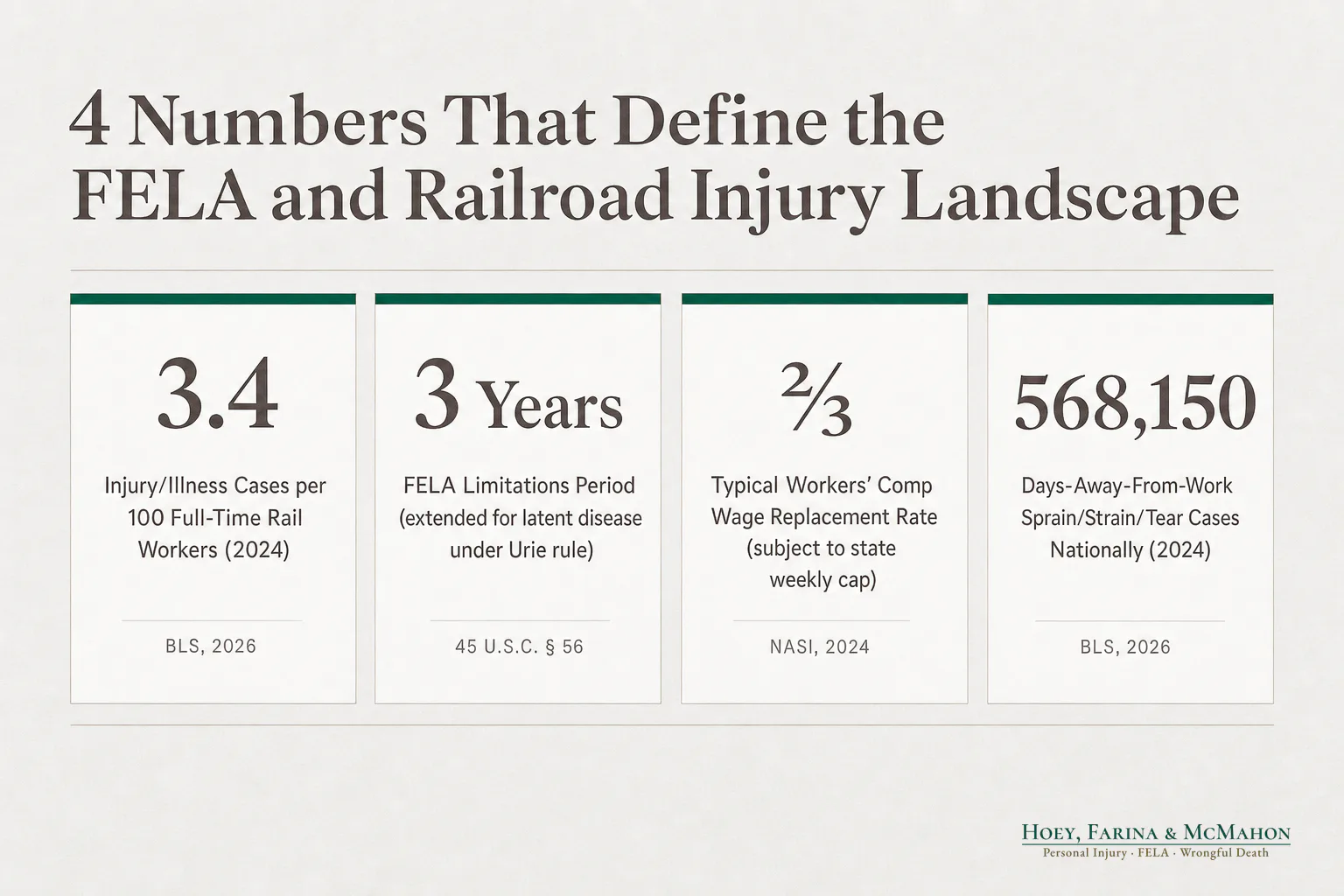
Most railroad workers assume they are covered by state workers' compensation after an on-the-job injury. They are not. Congress displaced state workers compensation entirely when the federal government passed the Federal Employers' Liability Act (FELA) in 1908, replacing no-fault benefits with a federal negligence remedy, and the U.S. Supreme Court later held that remedy exclusive within its field. Rail transportation recorded 3.4 injury and illness cases per 100 full time workers in 2024, according to the U.S. Bureau of Labor Statistics, and almost none of those injuries produced a railroad workers compensation claim in a state system. Congress did not merely supplement state workers' compensation — it displaced it entirely, replacing no-fault benefits with a federal negligence remedy that allows full recovery of wages, medical costs, and pain and suffering. That substitution changes what a railroad worker must prove, what can be recovered, and where the case is heard.
How FELA Replaces State Compensation and What That Substitution Requires
- Railroad workers covered by FELA cannot pursue state workers compensation claims, because federal law occupies the field.
- FELA requires proof that railroad negligence played "any part, even the slightest" in causing the injury. The reduced burden narrows the causation element. It does not remove it.
- FELA has no benefit schedule and no general compensatory damages cap, so pain and suffering and full future wage loss are recoverable, which differs from most state systems.
- A FELA claim is a lawsuit, not an administrative filing, and 45 U.S.C. § 56 sets a three year limitations period.
- Nothing pays automatically after a railroad injury, which makes early evidence preservation the practical difference between a provable claim and an unprovable one.
Why Railroad Workers Are Excluded From State Workers Compensation Systems
Railroad workers covered by FELA are excluded from state workers compensation laws because Congress occupied the field. In New York Central Railroad Co. v. Winfield (1917), the U.S. Supreme Court treated FELA as exclusive for covered employees and reversed a state compensation award.
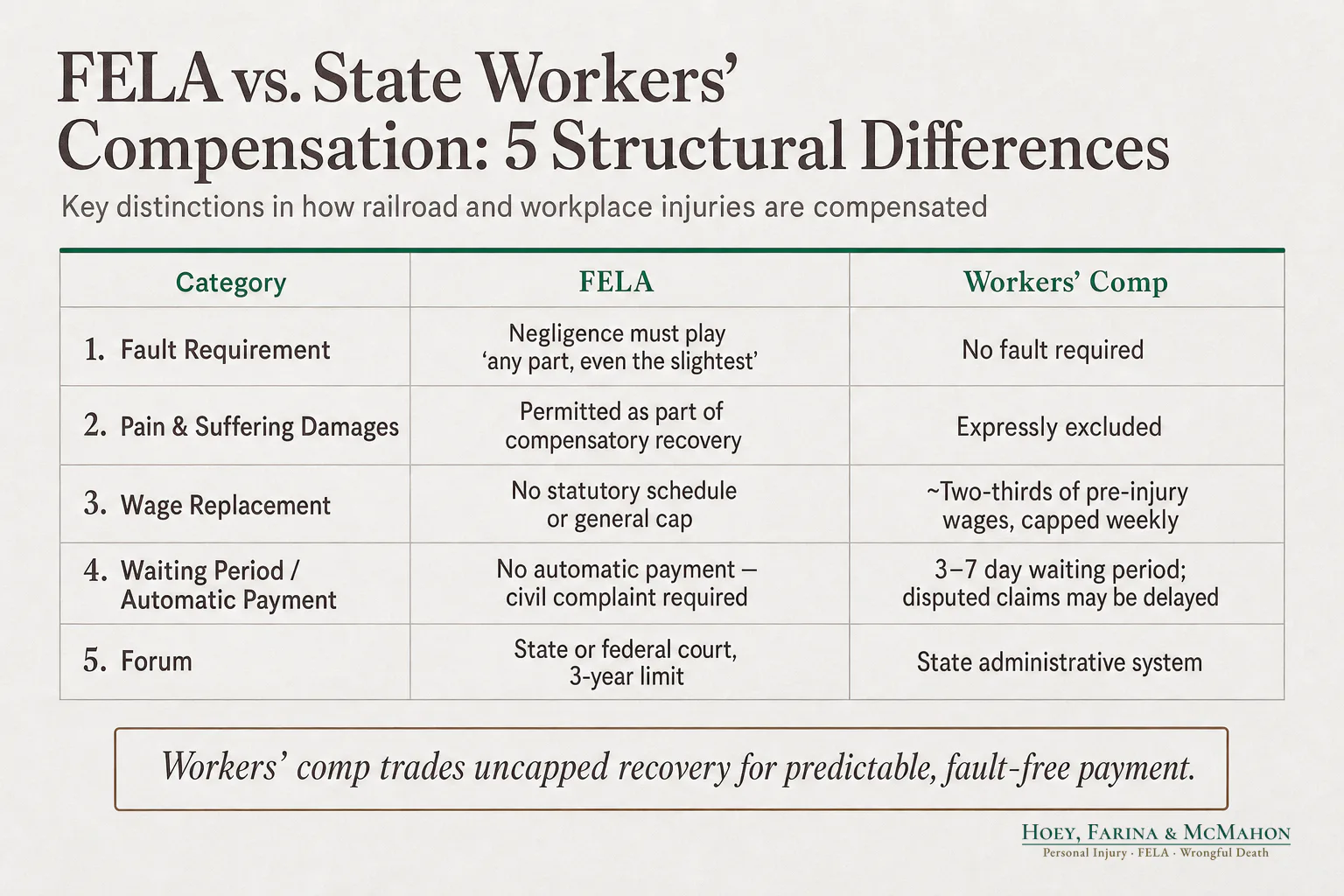
Coverage is functional, not determined by job title. The 1939 amendment to 45 U.S.C. § 51 asks whether duties further interstate commerce or directly, closely and substantially affect it. Reed v. Pennsylvania Railroad (1956) applied that test to an office clerk who maintained some 325,000 engineering tracings the Court described as indispensable to maintaining the railroad's operating system.
No form triggers payment. The worker must pursue a FELA claim and prove negligence.
What Railroad Workers Compensation Through the State System Would Have Provided
In most states, workers' compensation covers medical care and, after a waiting period of three to seven days depending on the state, pays a percentage of weekly wages—typically two-thirds—up to a state-set weekly maximum, generally without requiring proof of employer fault Social Security Administration, POMS DI 52120.001.
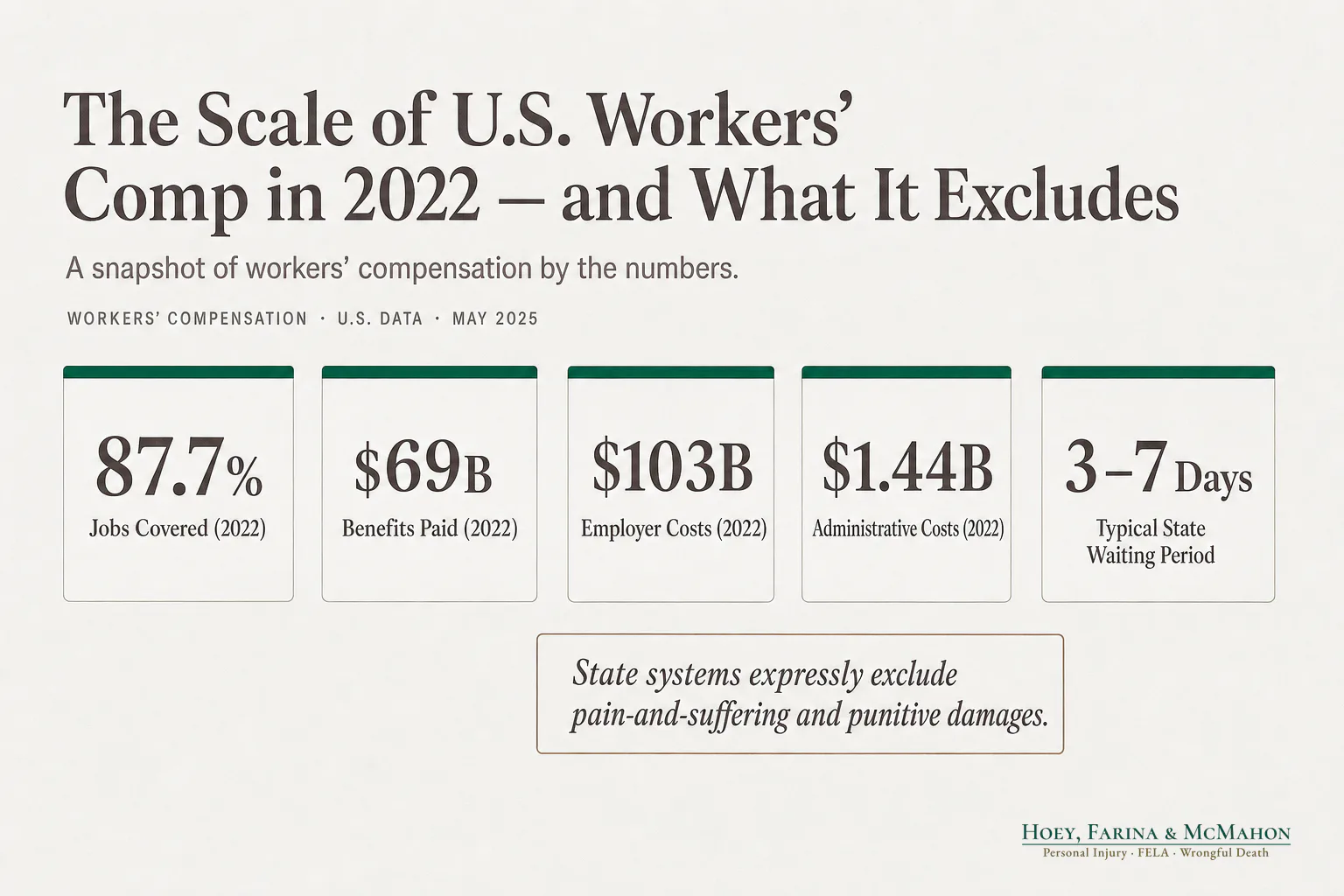
87.7 percent of jobs covered in 2022, $61.7 billion in benefits against $103 billion in employer costs, benefits down from $0.77 per $100 of wages in 2018 to $0.60 in 2022.
California's Division of Workers' Compensation excludes pain and suffering and punitive damages, the New York Workers' Compensation Board pays no cash until a judge resolves a disputed claim. So who pays an injured railroad worker's medical bills differs here.
How FELA Workers Compensation Differs on the Element That Controls Every Claim
FELA workers compensation turns on causation: Supreme Court precedent (CSX Transportation v. McBride, 2011) requires negligence play only "any part, even the slightest."
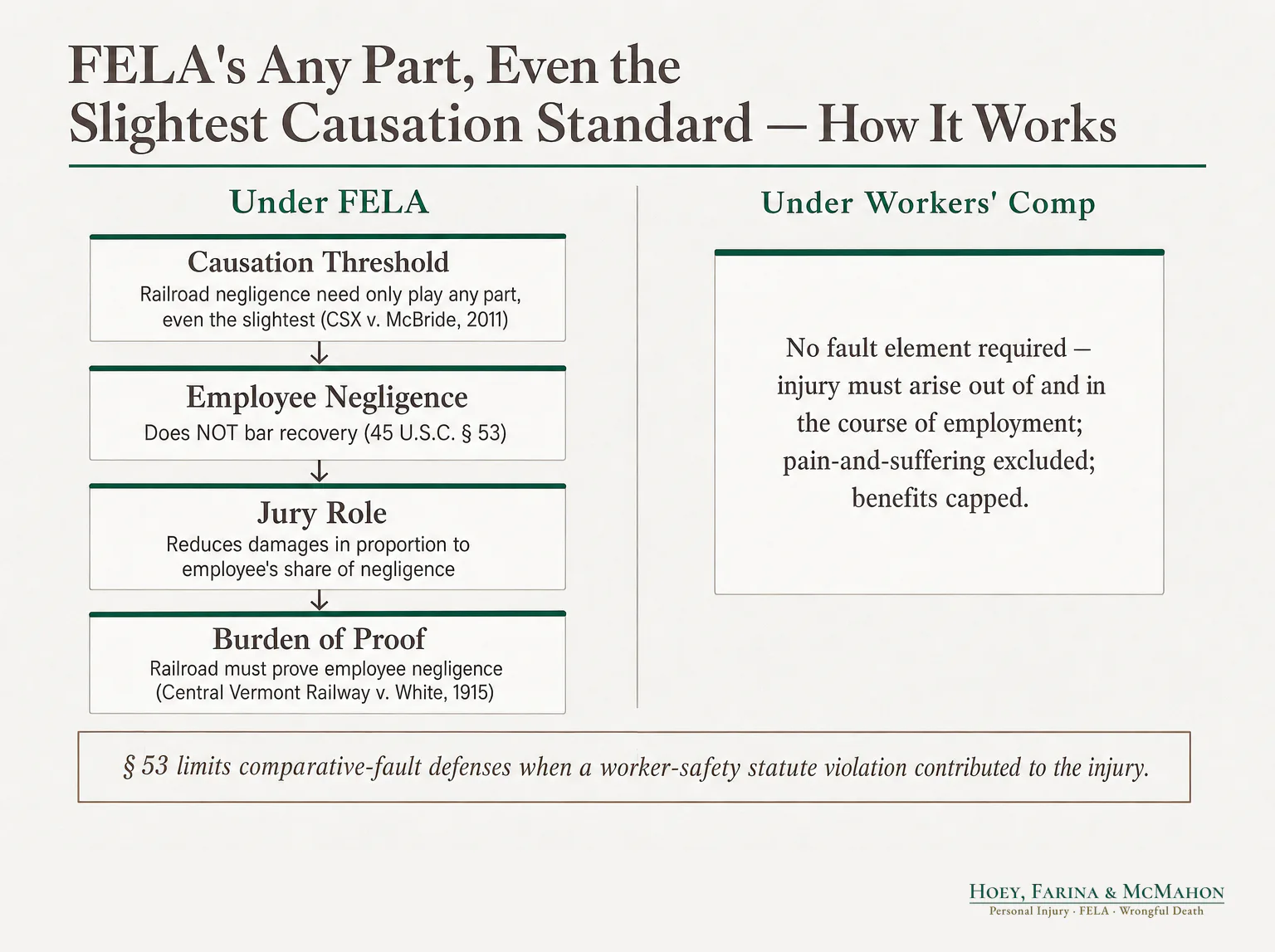
| Framework | Causation question |
|---|---|
| FELA | Negligence played any part, even the slightest |
| State workers compensation | Injury arose out of and in the course of employment |
| Common law negligence | Proximate or substantial cause |
Railroads often argue that
What the Federal Employers' Liability Act Workers Compensation Framework Allows a Worker to Recover
The Federal Employers' Liability Act workers compensation framework has no benefit schedule and no damages cap. Recovery is limited by proof, present value, and comparative fault.
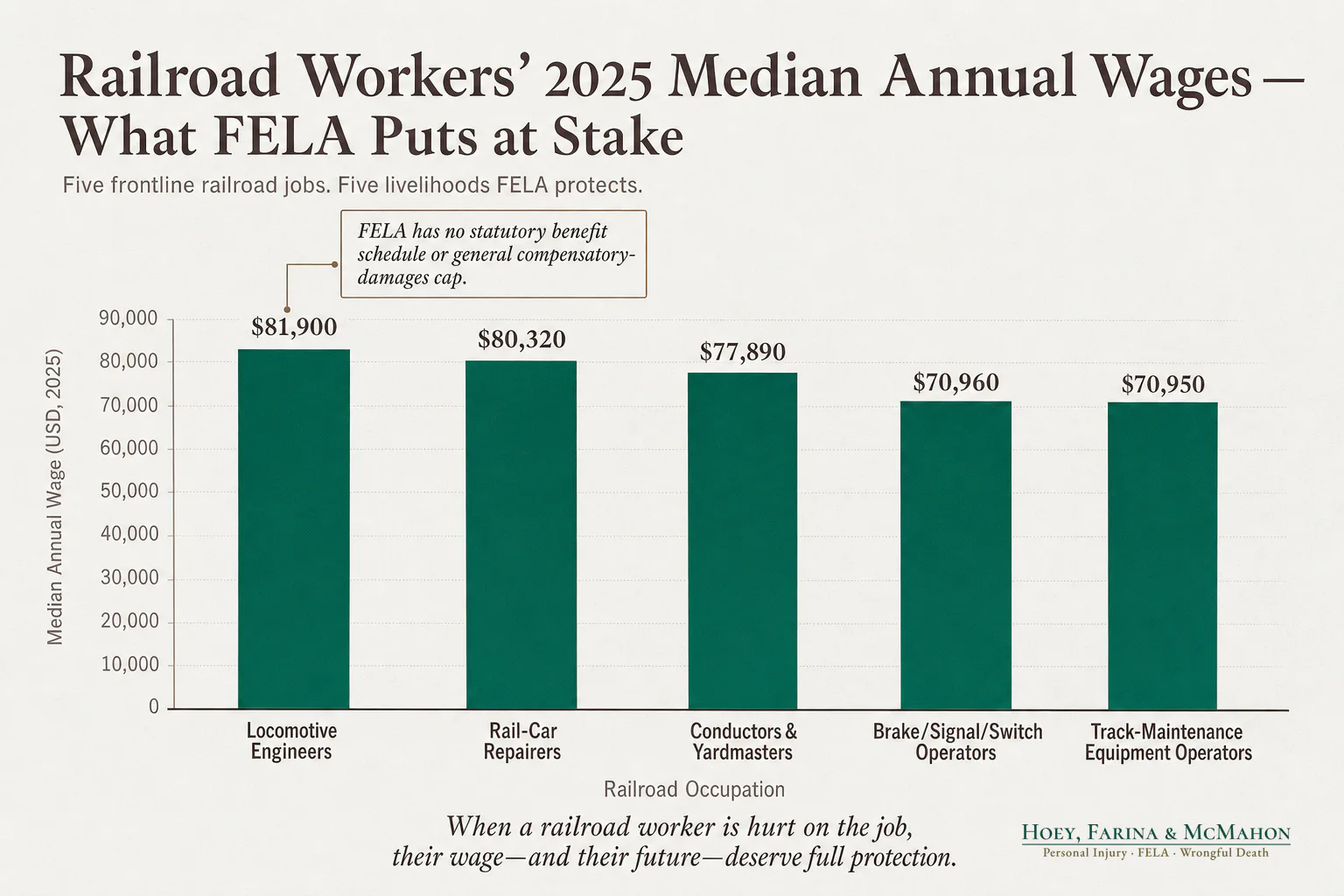
BLS OEWS medians (May 2022 to 2023): $74,770 locomotive engineers, $68,180 conductors and yardmasters, $67,540 brake, signal and switch operators and locomotive firers, $67,000 rail track laying and maintenance equipment operators, a category that includes machine operators, $62,510 rail car repairers. Compensation for railroad injuries varies by craft.
FELA covers pain and suffering. Norfolk & Western Railway v. Ayers (2003) let asbestosis claimants seek fear of cancer damages (Supreme Court), reaching FELA respiratory injury claims. Michigan Central Railroad v. Vreeland (1913) limits survivors to pecuniary loss.
How a FELA Claim Moves Through Federal Court Rather Than an Administrative System
FELA claims are civil lawsuits, not administrative filings, and the legal process differs significantly from a standard workers compensation system. 45 U.S.C. § 56 sets a three year limitations period and concurrent state and federal jurisdiction, 28 U.S.C. § 1445(a) bars removal of state court FELA cases.
Urie v. Thompson, 337 U.S. 163 (1949), refused to punish a worker's "blameless ignorance" and held that a cumulative occupational disease claim accrues when the worker knew or should have known of the injury, establishing the discovery rule for latent disease claims under FELA.
Discovery reaches maintenance, inspection, training and incident records, deciding what a shoulder or other repetitive trauma claim can prove.
What an Injured Railroad Worker Should Do Before Anything Else
Report the injury, get treated, preserve the facts. Under 49 C.F.R. Part 225, the FRA requires reporting qualifying employee injuries on Form FRA F 6180.55a, internal recording on Form FRA F 6180.98, five year record retention, and prohibits harassment or intimidation discouraging injury reporting or treatment, overlapping Federal Railroad Safety Act (FRSA) retaliation law.
One trap worth noting is that 49 U.S.C. § 20903 bars using FRA accident reports in civil damages actions, so value lies in photographs, witness accounts, inspection logs and maintenance records. Documentation from a treating physician shapes the benefits an injured railroad worker can claim.
FAQ
Why don't railroad workers get workers' comp?
Congress created an exclusive federal negligence remedy for interstate rail employees through a federal statute — sometimes called the federal employer liability act — so state workers compensation laws cannot reach them. Coverage must be established under 45 U.S.C. § 51, which is how railroad workers actually recover for on duty injuries.
What does a railroad worker need to establish to bring a FELA claim?
A railroad worker must show that the employer railroad was negligent, that the negligence played at least some part in causing the injury, and that the claim is filed within the three year limitations period set by 45 U.S.C. § 56. Meeting each of these elements is required for a successful claim. Unlike state workers compensation, there is no administrative form to file and no no-fault benefit schedule, so understanding your legal options is essential.
How to file a FELA claim?
There is no administrative application. You file a civil complaint in an eligible state or federal court within three years, latent disease claims may accrue later under Urie.
What types of injuries are most commonly pursued under FELA?
Railroad workers most often bring FELA claims for musculoskeletal injuries including sprains, strains and tears, as well as cumulative trauma from repetitive motion and overexertion. Occupational disease claims, including respiratory conditions from diesel exhaust or asbestos exposure, are also common and may accrue later under the discovery rule established in Urie v. Thompson (1949).
The Trade Congress Made
Congress did not add a layer of protection for railroad workers; it replaced state workers compensation entirely with a federal negligence remedy. That replacement is the controlling fact every injured railroad worker must understand, and it shapes their legal rights from the moment of injury. Full recovery of wages, medical costs, and pain and suffering is possible under FELA, but only through proved negligence. The reduced causation standard lowers the bar, yet it does not eliminate it. Early documentation of the railroad's conduct is what separates a provable claim from an unprovable one, and seeking legal help promptly protects that evidence. Legal assistance from an experienced FELA attorney can make the difference in preserving critical facts.
Hoey, Farina & McMahon provides legal representation to railroad workers in FELA and FRSA matters nationwide. Get a Free Case Evaluation.
William J. McMahon, Attorney and Managing Partner, focuses his practice on federal railroad injury litigation.
This article is provided for general information and is not legal advice. Reading it does not create an attorney client relationship. Legal outcomes depend on the facts of each case, and past results do not guarantee a similar outcome. If you were injured working on the railroad, discuss your situation with qualified counsel.
William J. McMahon Attorney & Managing Partner Hoey, Farina and McMahon