
How Federal Law Governs Every Train Injury Claim Railroad Workers File
Key Takeaways
- FELA, not state workers' comp, is the principal injury remedy against a covered railroad employer, and it requires proof of negligence rather than mere employment. See how [FELA railroad injury](https://www.hoeyfarina.com/practice-areas/railroad-claims/fela-railroad-injury) claims are structured.
- Causation is satisfied if railroad negligence played any part, even the slightest, in producing the injury.
- Worker fault reduces damages proportionally under 45 U.S.C. § 53 and never bars the claim. Assumption of risk is unavailable to the railroad.
- Cumulative trauma counts. The three-year limitations period runs from when the worker knew or should have known the condition was work related.
- Retaliation for reporting an injury triggers a separate Federal Railroad Safety Act claim with a 180-day filing deadline.
*Written by William J. McMahon, Attorney & Managing Partner.* William J. McMahon is a trial attorney and partner at Hoey, Farina & McMahon in Chicago, representing injured railroad workers nationwide in FELA and FRSA cases. He is SMART-TD Designated Legal Counsel, a member of the Academy of Rail Labor Attorneys, and admitted to the United States Supreme Court and federal district courts across ten states. His verdicts include $10 million and $2.3 million for injured railroaders, the firm's record includes a $33 million FELA verdict, and Leading Lawyers named him a Top Ten FELA attorney in Illinois in 2021 and 2022.
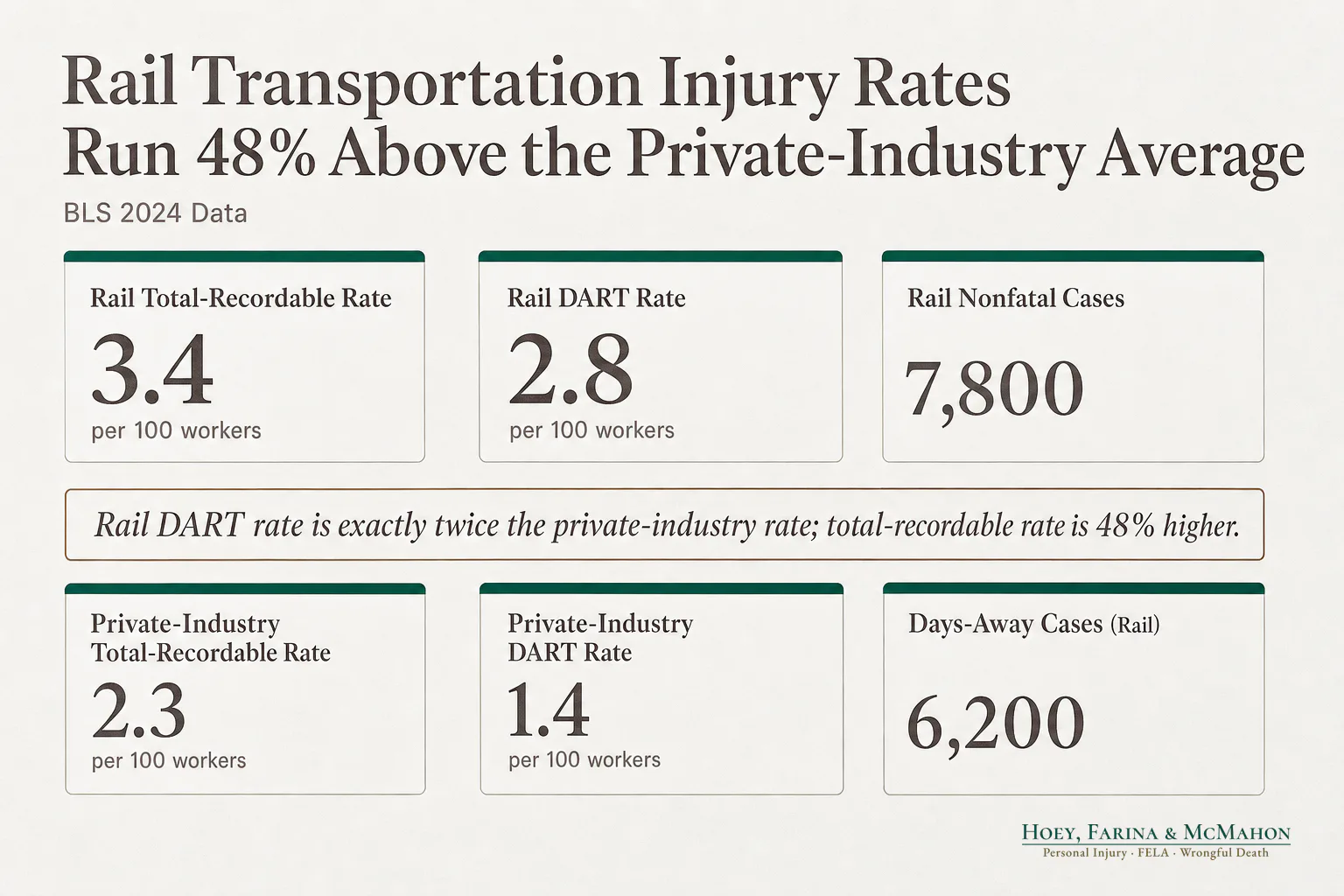
Most railroad workers assume that a train injury on the job is handled the same way any other workplace injury would be — through state workers' compensation. That assumption is wrong, and it costs workers. A railroad worker who suffers a train injury does not file a state workers' compensation claim; the Federal Employers' Liability Act supplies the remedy instead, and that single fact changes who must prove what. Rail transportation workers recorded injuries at a rate of 3.4 cases per 100 full-time workers in 2024, roughly 48% above the rate of 2.3 for private industry as a whole, according to the Bureau of Labor Statistics.
Why a Train Injury Claim Follows Federal Law, Not State Workers' Comp
Congress passed the Federal Employers' Liability Act in 1908 because railroading was deadly. FELA, not state workers' comp, governs a train injury claim. Rail's days-away-or-restricted rate was 2.8 in 2024, twice private industry's 1.4.
Who FELA covers
45 U.S.C. § 51 covers any employee whose duties in any part further interstate commerce. Railroads often argue that a worker whose job is purely local or administrative falls outside FELA's reach. Kelley v. Southern Pacific Co. rejected that narrow view, holding that the test is whether the employee's work, taken as a whole, furthers interstate commerce — not whether any single task crossed a state line. The practical consequence for workers is that most railroad employees, from engineers to maintenance crews, qualify for FELA protection in railroad claims.
What the injured railroad worker must prove
Under Rogers v. Missouri Pacific Railroad Co., a jury question exists when railroad negligence "played any part, even the slightest," but negligence must still be proven, how railroad workers recover for injuries.
The Most Common Train Injuries Railroad Workers Sustain on the Job
A train injury may be a single incident such as a fall from equipment, being struck by moving cars, or derailment trauma caused by human error, or it may be cumulative damage from lifting, vibration, and repetitive motion. Each type is actionable when railroad negligence or a statutory violation contributed and the claim is timely.
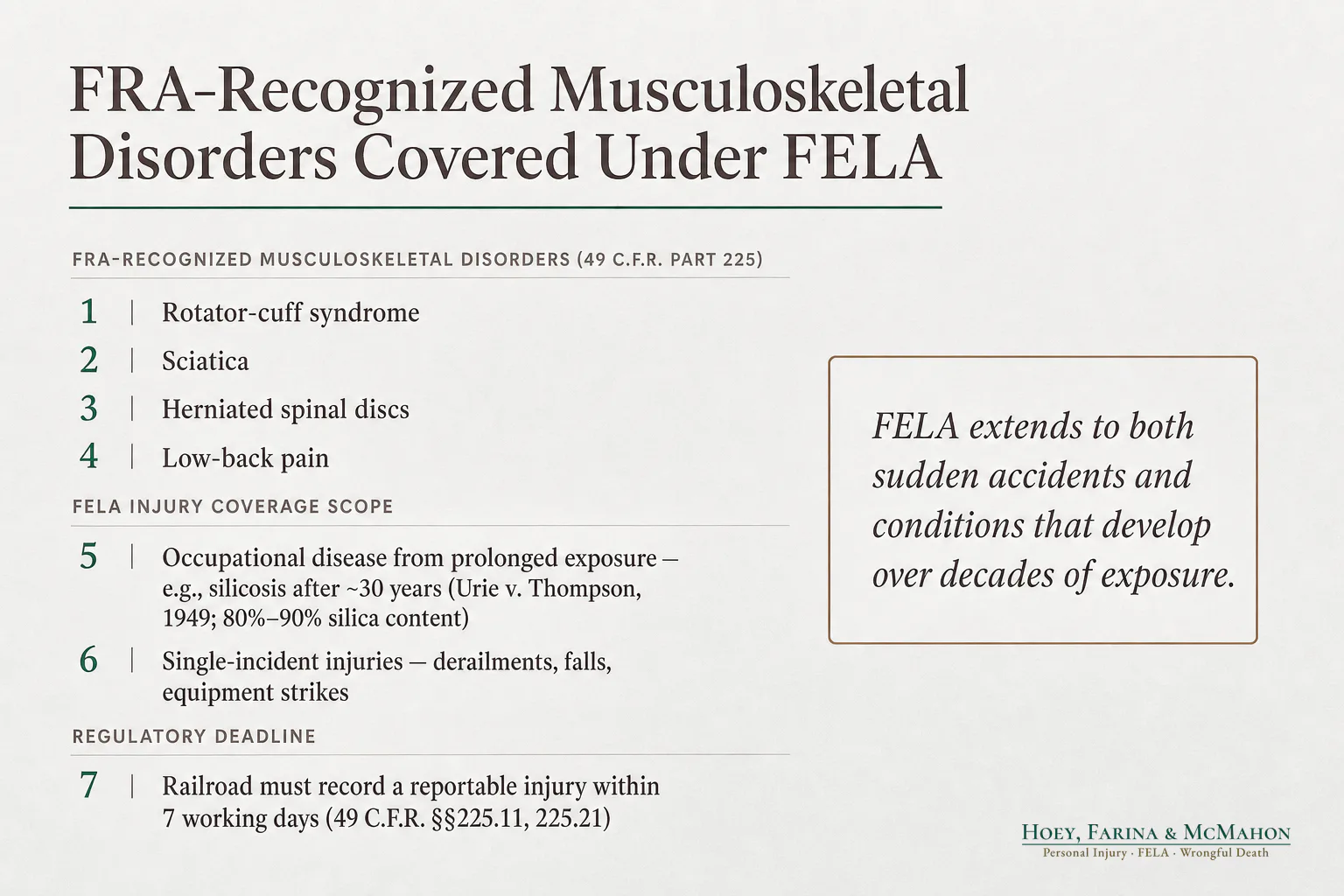
Federal Railroad Administration recordkeeping regulations treat musculoskeletal disorders as a broad category of reportable occupational injury, covering disorders of the muscles, nerves, tendons, ligaments, joints, cartilage, and spinal discs. A case is reportable when it is work related, is a new case, and meets one or more general reporting criteria such as days away from work, restricted work, or medical treatment beyond first aid. Urie v. Thompson allowed recovery for silicosis developed over roughly 30 years of exposure to sanding material containing 80% to 90% silica. Nationally, overexertion and repetitive motion remain the leading cause of serious lost-time cases, mirroring what railroad workers report across the country.
Injuries linked to defective railroad equipment
The Locomotive Inspection Act, 49 U.S.C. § 20701 and 49 C.F.R. § 229.7, requires locomotives and appurtenances to be safe to operate without unnecessary peril. A proven violation imposes an absolute statutory duty, removing ordinary negligence and comparative fault. The worker must still establish applicability, violation, and causation.
How the Railroad's Duty of Care Differs From What Most Workers Expect
FELA's safe-workplace duty is continuous and nondelegable. Railroads sometimes argue that when a contractor caused the hazard, the railroad bears no responsibility. Sinkler v. Missouri Pacific Railroad Co. closed that gap by holding that a contractor performing railroad operations acts as the railroad's agent, so the contractor's negligence is attributed directly to the carrier. The worker therefore does not need to sue the contractor separately; the railroad remains the responsible defendant.
Three Federal Regulatory Pillars of the Railroad's Non-Delegable Duty — Source: 49 C.F.R. Parts 213, 228, 229, eCFR 2026; 45 U.S.C. §53, U.S. Code 2023; Tiller v. Atlantic Coast Line R.R., 323 U.S. 574 (1945)
Part 213 covers track inspection, Part 229 locomotive condition and § 229.21 daily inspection records, Part 228 hours-of-duty records (§ 228.9), hours limits sit in 49 U.S.C. chapter 211.
What the railroad must prove to reduce the award
Under 45 U.S.C. § 53, worker negligence proportionally reduces damages rather than barring recovery, and no reduction applies where the railroad's violation of a federal safety statute contributed to the injury or death. Courts have held that the railroad bears the burden of proving any contributory negligence. Tiller ended assumption of risk.
What Damages a Successful Train Injury Claim Can Recover
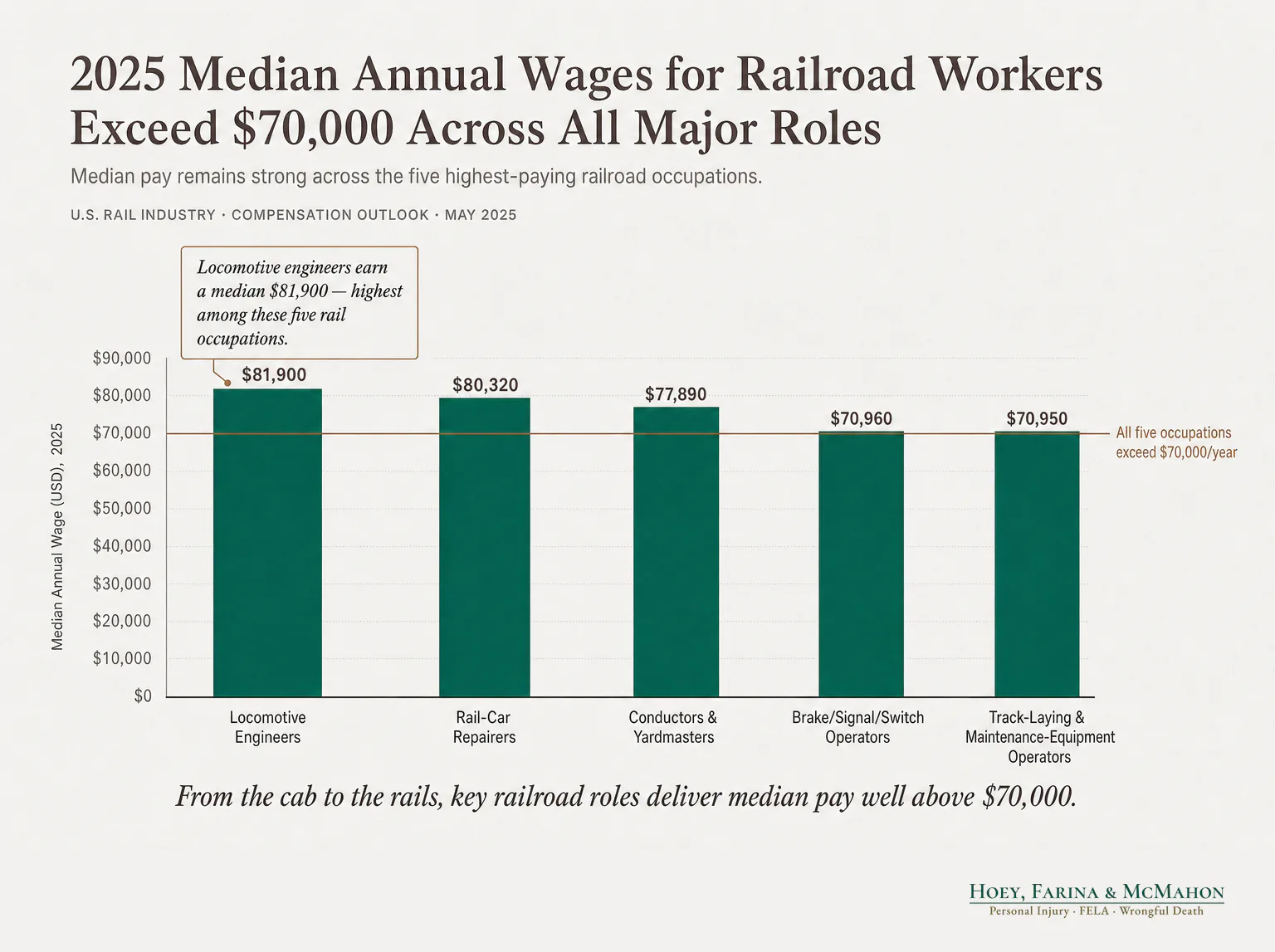
FELA damages are uncapped and include lost wages, medical expenses, and pain and suffering. BLS 2025 data put median annual wages at $81,900 for locomotive engineers, $80,320 for rail car repairers, $77,890 for conductors and yardmasters, and $70,960 for brake, signal, and switch operators. Because railroad wages are well above the national median, even a months-long absence from work can produce a six-figure lost-earnings claim, making the uncapped nature of FELA damages especially significant.
Wrongful death under FELA
Under FELA, a fatal train injury claim belongs first to the worker's spouse and children; if none survive, it passes to the worker's parents; and if no parents survive, to dependent next of kin.
What Railroad Workers Should Do Immediately After a Train Injury
Report the train injury in writing. See train accident claims for a full guide to the steps railroad workers should take after an on-the-job injury.
Preserve what the railroad controls
Event recorders hold only 48 hours, one-year preservation follows only FRA reportable accidents, demand a legal hold now.
The three-year limitations period
FELA, three years, under Urie, latent-disease and cumulative-trauma claims accrue when the worker should have known the cause. See train accident claims.
How FRSA Whistleblower Protection Connects to a Train Injury Claim
The Federal Railroad Safety Act protects good faith injury reporting and requests for medical treatment. Refusing unsafe work is protected only when the statute's good faith, imminent danger, urgency, and reasonable alternative conditions are met. Retaliation for exercising these rights is a separate violation from the underlying injury claim.
A complaint must reach the Occupational Safety and Health Administration within 180 days of the retaliatory act. The worker must show protected activity was a contributing factor, after which the railroad must prove by clear and convincing evidence it would have acted the same way regardless. Remedies include reinstatement with seniority, back pay with interest, and punitive damages capped at $250,000.
Frequently Asked Questions About Train Injury Claims
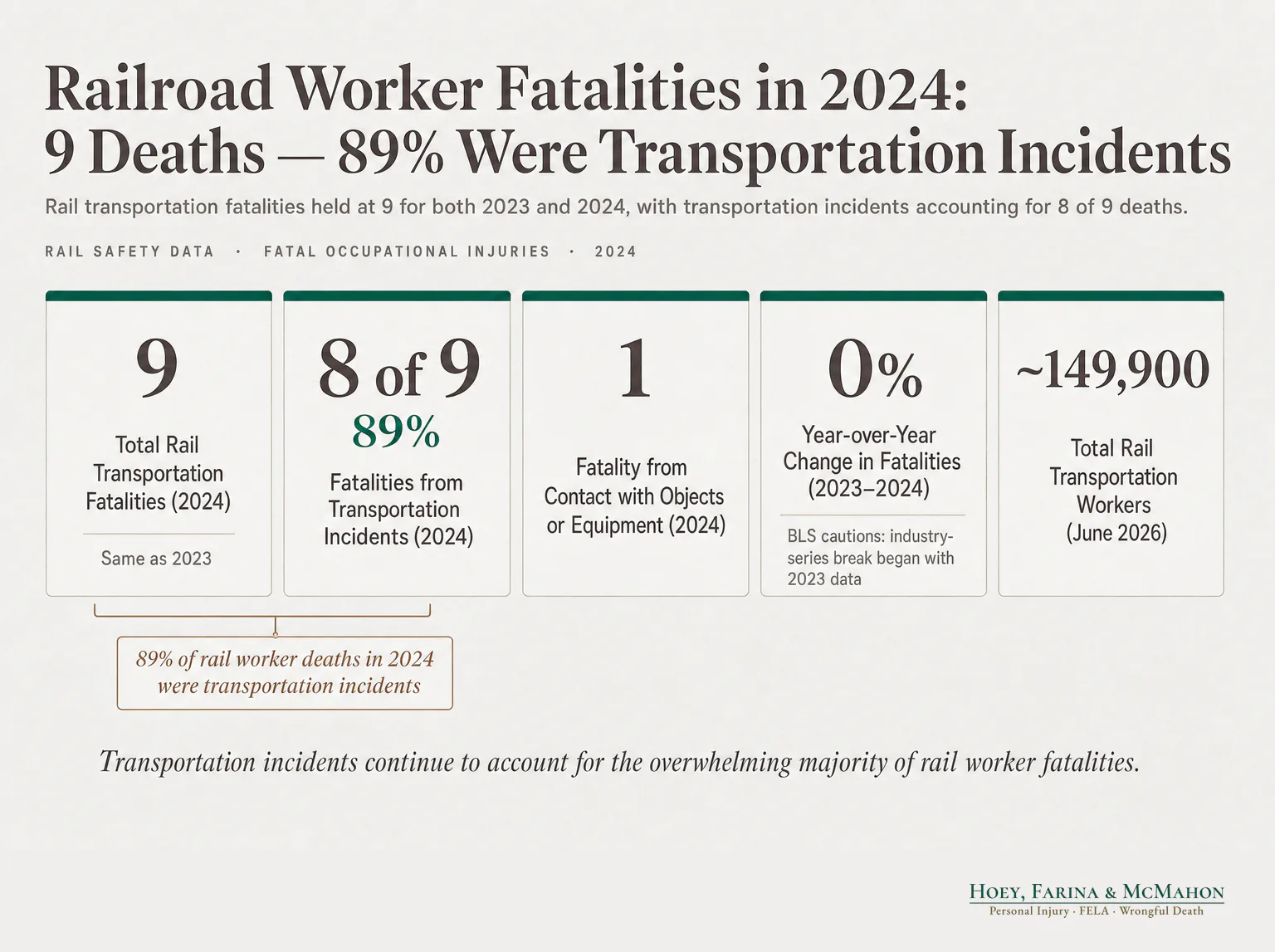
What is the most common type of train accident for railroad workers?
Does FELA cover injuries that developed gradually?
Yes, cumulative trauma and occupational disease qualify, and timeliness follows the Urie discovery rule.
Can the railroad discipline a worker for filing a claim?
No. Retaliation violates 49 U.S.C. § 20109 and supports an FRSA complaint, filed with OSHA within 180 days.
What role does the National Transportation Safety Board play?
It investigates major accidents, but 49 U.S.C. § 1154(b) limits use of its reports in civil litigation, independent evidence stays discoverable, including in passenger injury matters.
What a Train Injury Claim Actually Requires From the Railroad Worker
FELA shifts the legal landscape in the worker's favor: it eases the causation standard, bars the railroad from invoking assumption of risk, and caps comparative fault rather than using it to bar recovery entirely, helping workers understand their legal rights. But the statute does not eliminate the worker's burden. The worker must still prove that railroad negligence contributed to the injury, even in the slightest degree. Early reporting, prompt medical treatment, and preservation of records determine what evidence survives long enough to prove that case.
William J. McMahon is Attorney and Managing Partner at Hoey, Farina & McMahon, SMART-TD Designated Legal Counsel, whose practice focuses on nationwide FELA litigation for injured railroad workers.
This article is provided for general information and is not legal advice. Reading it does not create an attorney client relationship. Legal outcomes depend on the facts of each case, and past results do not guarantee a similar outcome. If you were injured working on the railroad, discuss your situation with qualified counsel.
William J. McMahon Attorney & Managing Partner Hoey, Farina and McMahon