
How a FELA Case Works From the First Week to a Verdict
Key Takeaways
- The Federal Employers’ Liability Act, not state workers’ compensation, governs on-the-job injuries to railroad workers whose duties further or affect interstate commerce.
- The worker must show railroad negligence played any part, even the slightest, in causing the injury.
- No provision of FELA requires a recorded statement to a railroad claim agent.
- The Federal Railroad Safety Act (FRSA) bars retaliation for reporting an injury in good faith or following a treating physician's orders.
- A FELA claim generally must be filed within three years. An FRSA retaliation complaint has only 180 days.
*Written by William J. McMahon, Attorney & Managing Partner.* William J. McMahon is a trial attorney and partner at Hoey, Farina & McMahon in Chicago, representing injured railroad workers nationwide in FELA and FRSA cases. He is SMART-TD Designated Legal Counsel, a member of the Academy of Rail Labor Attorneys, and admitted to the United States Supreme Court and federal district courts across ten states. His verdicts include $10 million and $2.3 million for injured railroaders, the firm's record includes a $33 million FELA verdict, and Leading Lawyers named him a Top Ten FELA attorney in Illinois in 2021 and 2022.
The personal injury report a railroad worker signs on the day of the injury is often the first document the railroad relies on in a Federal Employers’ Liability Act (FELA) case, the federal employers liability act claim that governs railroad injuries. A FELA case is not workers’ comp. The injured railroad worker ordinarily must prove the railroad was negligent. Federal law then reduces the causation burden and strips the railroad of defenses it would have in an ordinary injury suit. What happens in the first days shapes how much of that proof survives.
This article is general information, not legal advice, and reading it does not create an attorney-client relationship.
Which Railroad Worker Injury Cases Can Lead to FELA Claims?
A railroad worker injury supports a FELA claim when railroad negligence or a safety statute violation contributed, whether on a train or elsewhere on railroad property.
How do slips and falls on ballast and walkways cause injuries?
Uneven ballast, spilled lubricant, debris and poor lighting cause ankle, knee and back injuries. See FELA claims for slip and fall injuries on the railroad's duty to provide a reasonably safe workplace.
Why do equipment and coupling injuries carry special weight?
The Federal Safety Appliance Act, 49 U.S.C. § 20302, requires automatic couplers, efficient handbrakes, sill steps and grab irons. The Locomotive Inspection Act, 49 U.S.C. § 20701, requires safe locomotives. A contributing violation removes the negligence burden and bars reducing the award for worker fault.
How do repetitive trauma and toxic exposure injuries develop?
Cumulative injuries build over years from rough-riding seats, switch throwing and vibration, as do respiratory injuries from diesel exhaust, asbestos or silica. Urie v. Thompson refused to start the filing deadline at first exposure for silicosis. The FELA statute of limitations generally runs from when the worker knew or should have known the injury was work-related.
What Makes a FELA Case Different From Workers’ Comp?
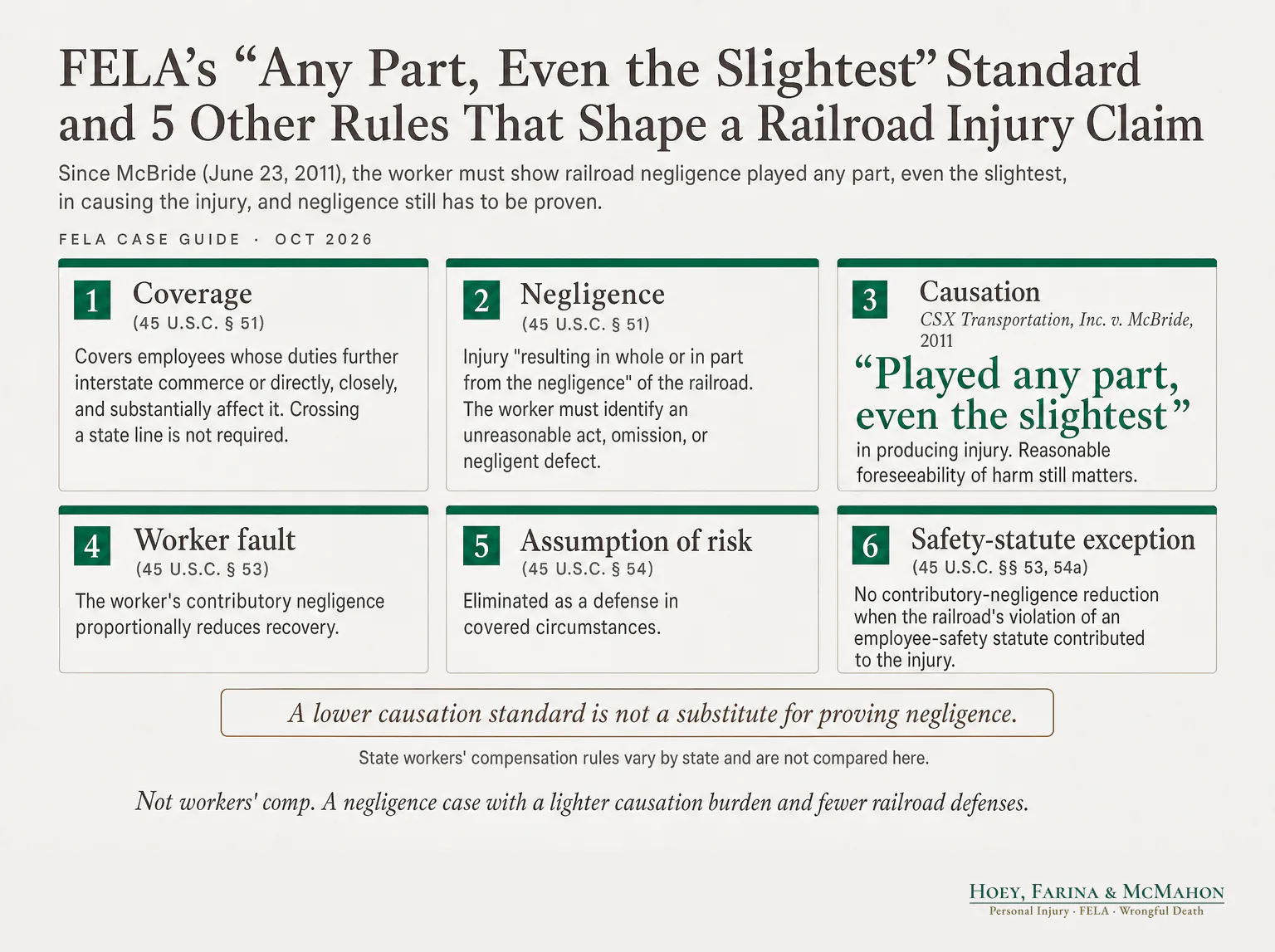
A FELA case is a negligence lawsuit, not a no-fault claim. The worker must prove fault, but FELA damages are uncapped (see what railroad workers’ compensation doesn't cover).
Why does a railroad worker have to prove negligence?
45 U.S.C. § 51 makes railroads liable for injury "resulting in whole or in part from the negligence," displacing state workers’ comp how FELA governs railroad worker injury claims. Proof of a successful fela claim requires an unreasonable act, omission or defect.
How much does the worker have to prove about causation?
Negligence need only have "played any part, even the slightest," per CSX Transportation, Inc. v. McBride, 564 U.S. 685 (2011). Foreseeability still matters.
Which defenses does the railroad lose, and which does it keep?
Section 54 bars assumption of risk. Under Section 53, comparative fault reduces recovery but never bars it. A contributing violation of these federal laws eliminates the reduction.
What Should an Injured Railroad Worker Do in the First Days After the Injury?
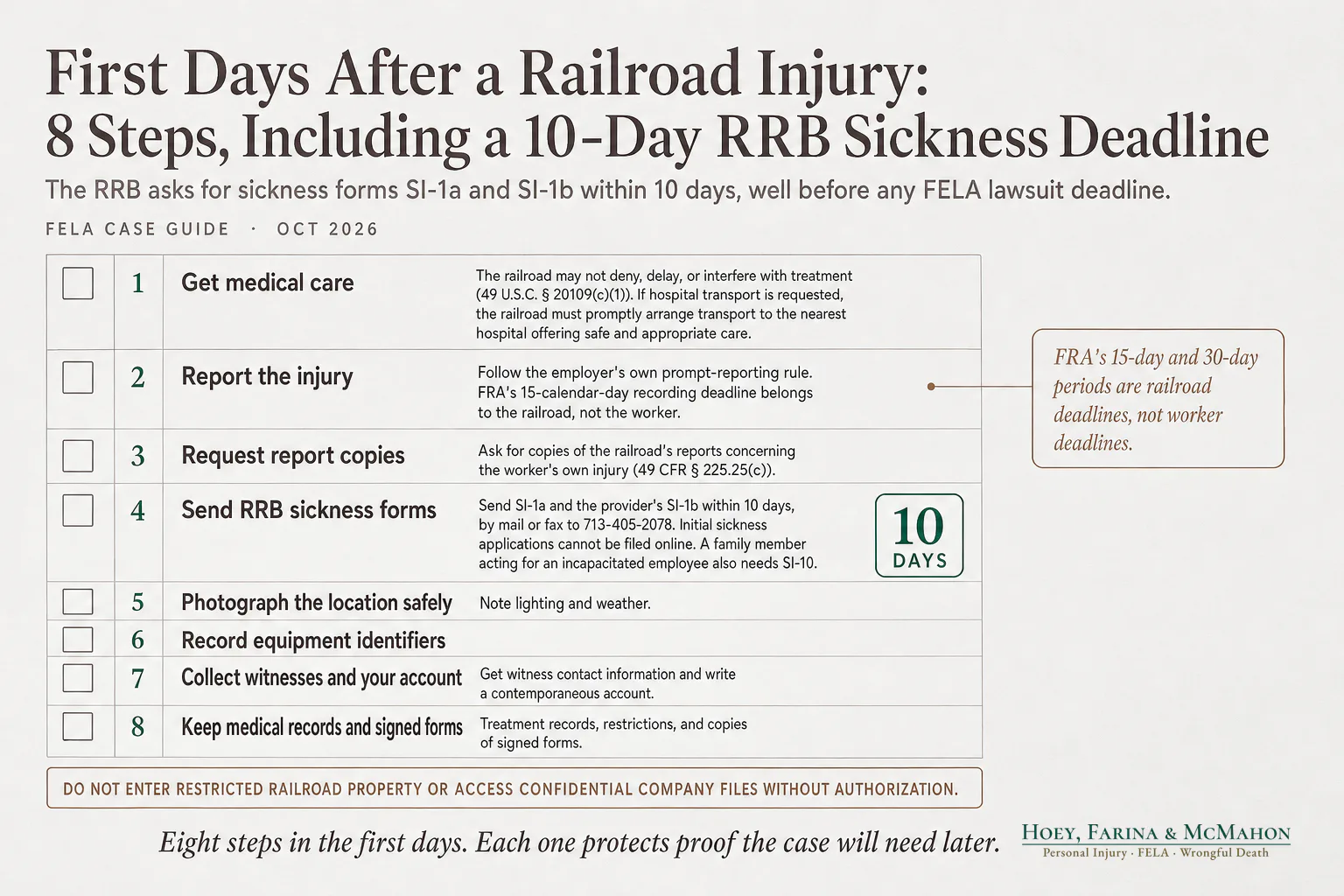
Report the injury, get care, preserve evidence and mail or fax Railroad Retirement Board sickness forms SI-1a and SI-1b within 10 days.
How should the injury be reported?
Factually list every injured body part, the defect and witnesses. 49 C.F.R. § 225.25(c) lets workers request the railroad's reports.
Does the worker have to use the railroad's doctor?
No. Under 49 U.S.C. § 20109(c)(1), railroads may not deny, delay or interfere with treatment. The railroad worker should tell providers it was a work injury, since medical documentation proves causation.
What evidence should be preserved right away?
Photograph the scene and note witnesses and equipment numbers before taking legal action. Counsel's preservation letter protects railroad-held video and recorder data.
What Should a Railroad Worker Expect From Claim Agents and the Investigation in a FELA Case?
A claim agent builds the railroad's FELA file. A disciplinary investigation examines rule violations, and railroad claim agents may attend.
Who does the railroad claim agent work for?
The railroad. SMART Transportation Division guidance distinguishes them from worker representatives and notes they gather photographs, witness statements and measurements.
Is a recorded statement required?
No. FELA requires none, so declining until hiring counsel or obtaining legal representation is reasonable. 45 U.S.C. § 60 voids rules stopping coworkers from sharing injury facts.
Under Callen v. Pennsylvania Railroad Co., a release signed with a claims agent is enforceable unless the worker proves fraud or mutual mistake.
How is the formal investigation different from the claim?
A disciplinary investigation, held under the collective bargaining agreement, decides whether the worker broke a railroad rule. The FELA claim asks a different question: whether railroad negligence played any part in the injury.
The railroad can offer the hearing transcript as lawsuit evidence, treating the worker's answers as admissions. An unprepared statement accepting blame can weaken proof of negligence and increase the comparative fault reduction under Section 53, so legal support before the hearing matters.
What Protects a Railroad Worker From Retaliation After an Injury?
The FRSA protects legal rights by barring retaliation for reporting work injuries.
What does the FRSA prohibit?
Section 20109(a)(4) protects reporting a work injury. Section 20109(c)(2) protects following a physician's orders. The statute defines discipline broadly, including suspension and termination. Per OSHA's FRSA investigator guidance, protected activity need only be a contributing factor. The railroad must prove by clear and convincing evidence it would have acted anyway. 49 C.F.R. § 225.33 requires policies against intimidation.
How fast must a retaliation complaint be filed?
An FRSA complaint goes to OSHA within 180 days of the retaliatory act. Department of Labor regulations allow oral complaints. 29 C.F.R. § 1982.103 permits tolling for reasons warranted by applicable case law, and courts grant equitable tolling sparingly, only in extraordinary circumstances. Legal options and remedies include reinstatement, back pay and compensatory damages. Punitive damages are capped at $250,000.
How Do Railroad Lawsuits Under FELA Move From Filing to Settlement or Trial?
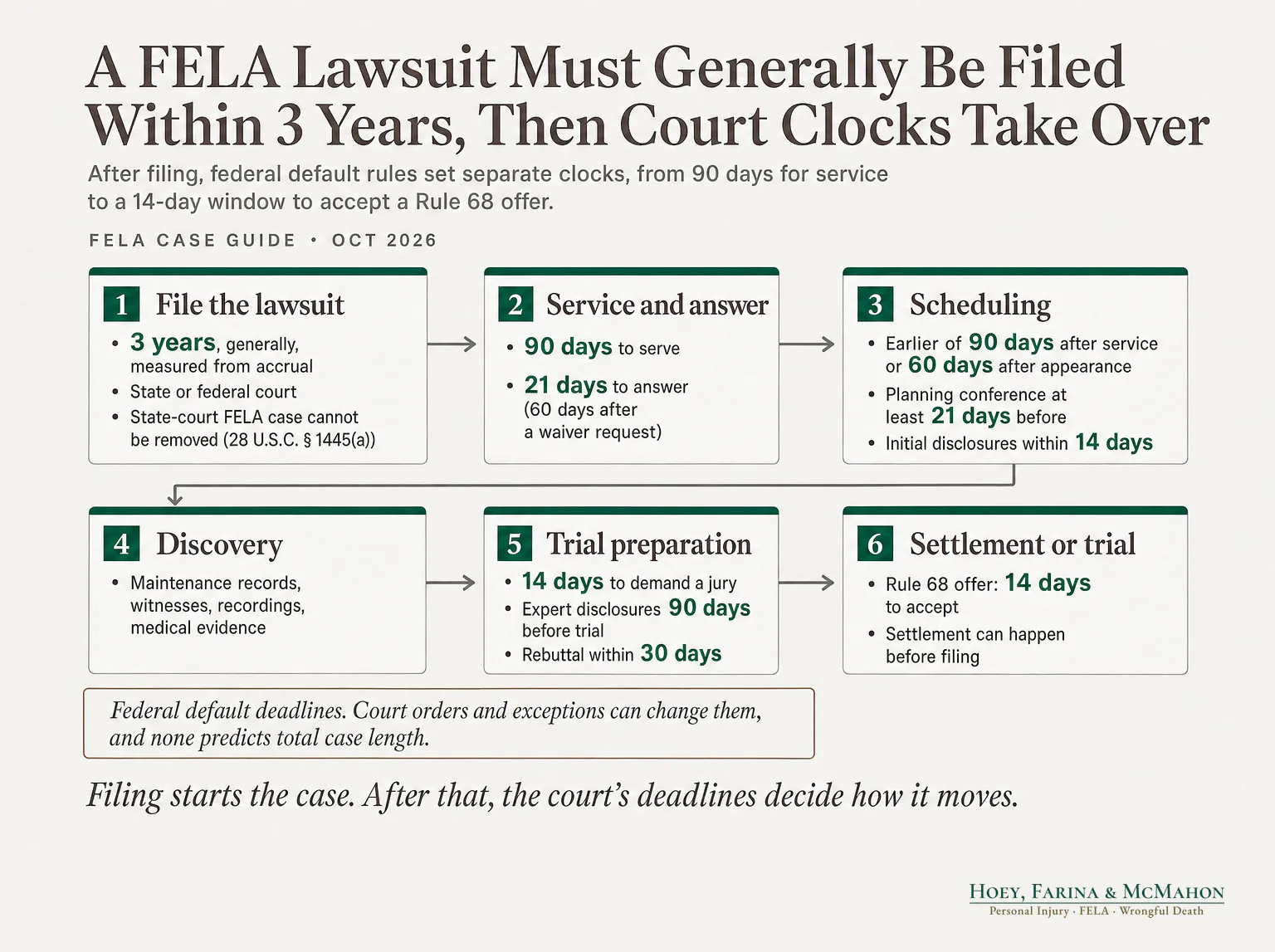
In this legal process, a FELA lawsuit generally must be filed within three years.
When and where can a FELA lawsuit be filed?
45 U.S.C. § 56 runs the three years from accrual, and reporting the injury or negotiating does not pause it. Under 28 U.S.C. § 1445(a), a state court FELA case cannot be removed to federal court.
What happens during discovery?
Evidence exchanged includes maintenance records, FRA injury reports, event recorder data, and crew depositions, which the worker's legal team reviews.
How do settlement and trial work?
Settlement can close a case at any stage. Otherwise, a jury decides negligence, causation, comparative fault and damages. Sickness benefits are generally reimbursed under 45 U.S.C. § 362(o), which gives the Railroad Retirement Board a lien. A release is final. See railroad injury settlements.
Common FELA Case Questions on Proof, Death Claims and Sickness Benefits
What is a FELA claim?
A FELA claim is a railroad worker's negligence suit under the 1908 Federal Employers' Liability Act, sometimes called the federal employer liability act. Its compensation for railroad injuries has no fixed benefit schedule.
What are the four proofs of negligence, and how do they apply in a FELA case?
They are duty, breach, causation and damages. Under McBride, causation is met if railroad negligence played even the slightest part.
What is considered employee negligence in a railroad injury case?
Employee negligence is a worker's failure to use reasonable care. Under 45 U.S.C. § 53, it reduces awards proportionally, never bars recovery and is disregarded after safety statute violations.
How hard is it to win a FELA case?
No outcome is guaranteed, and legal experience helps. Winning requires proof that railroad negligence contributed to the injury.
Can a family bring a FELA case if a railroad worker dies?
Yes. The personal representative sues under 45 U.S.C. § 51 for the spouse and children, or else parents or dependent next of kin. A 45 U.S.C. § 59 survival claim covers pre-death losses, and families often seek legal help with it.
Can a railroad worker collect Railroad Retirement Board sickness benefits during a FELA claim?
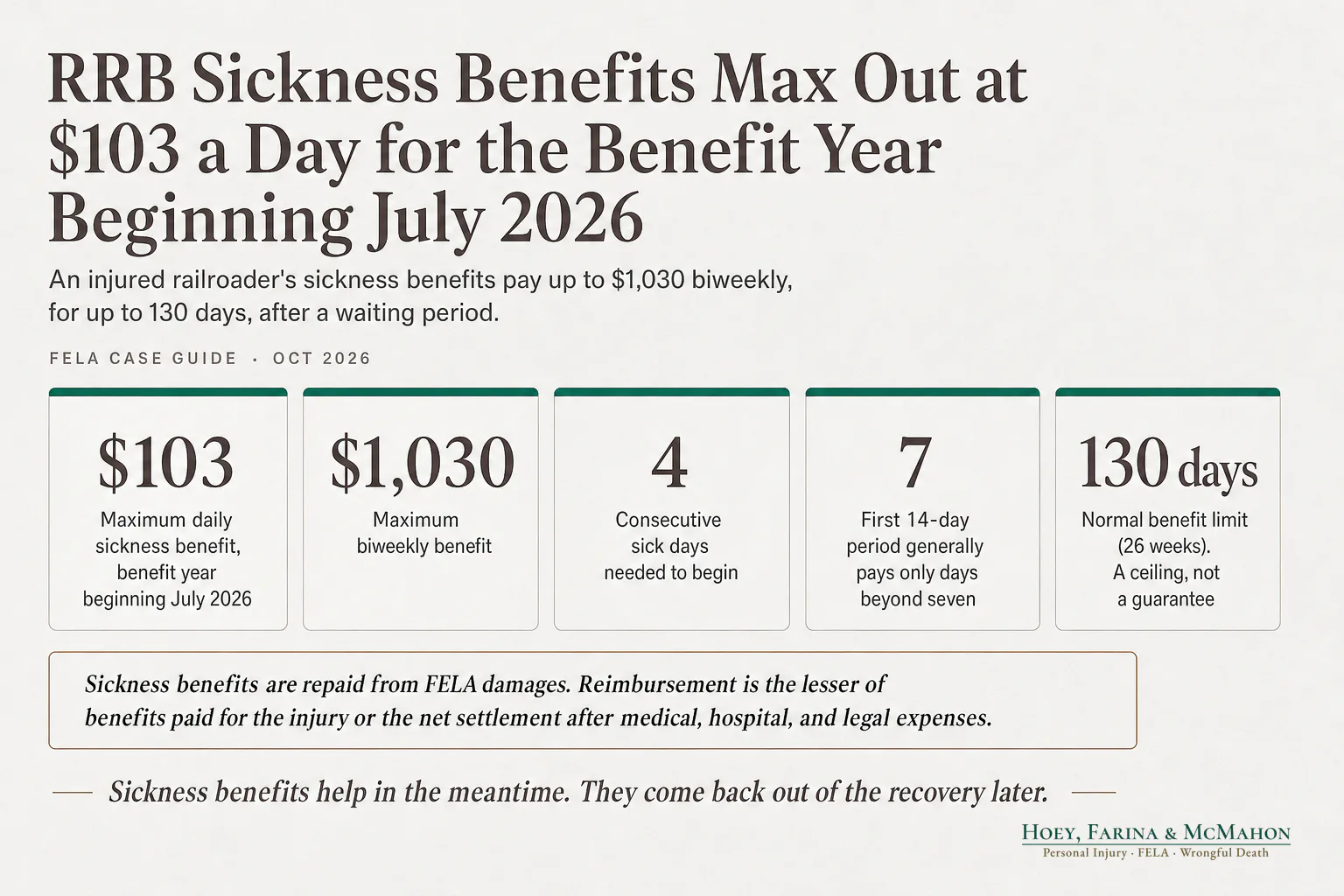
Generally yes, within the RRB cap of $103 a day, or $1,030 biweekly, for the year beginning July 2026. Under the RRB sickness benefits pamphlet rules, benefits are normally payable for days of sickness over four in a 14-day period, the first claim in a period of continuing sickness generally involves a seven-day waiting period, subject to exceptions, and later recoveries generally reimburse benefits.
Why Does the First Week After a Railroad Injury Shape the Whole FELA Case?
FELA still requires proving railroad negligence played a part, which raises legal issues early. That proof comes from the injury report, medical record, claim agent file and hearing transcript, so SMART advises seeking counsel early.
Hoey, Farina & McMahon, P.C. provides legal assistance and handles FELA railroad injury claims nationwide from Chicago.
For a Free Case Evaluation, call (888) 425-1212 or request one online.
This article is provided for general information and is not legal advice. Reading it does not create an attorney client relationship. Legal outcomes depend on the facts of each case, and past results do not guarantee a similar outcome. If you were injured working on the railroad, seek early legal guidance and discuss your situation with qualified counsel.
William J. McMahon Attorney & Managing Partner Hoey, Farina and McMahon